

A trading simulator for learning how your strategy behaves
Most traders don’t fail because they never ran a backtest—they fail because they never understood how a strategy behaves when the market stops cooperating. A trading simulator is the bridge between “backtest results” and “execution reality.”
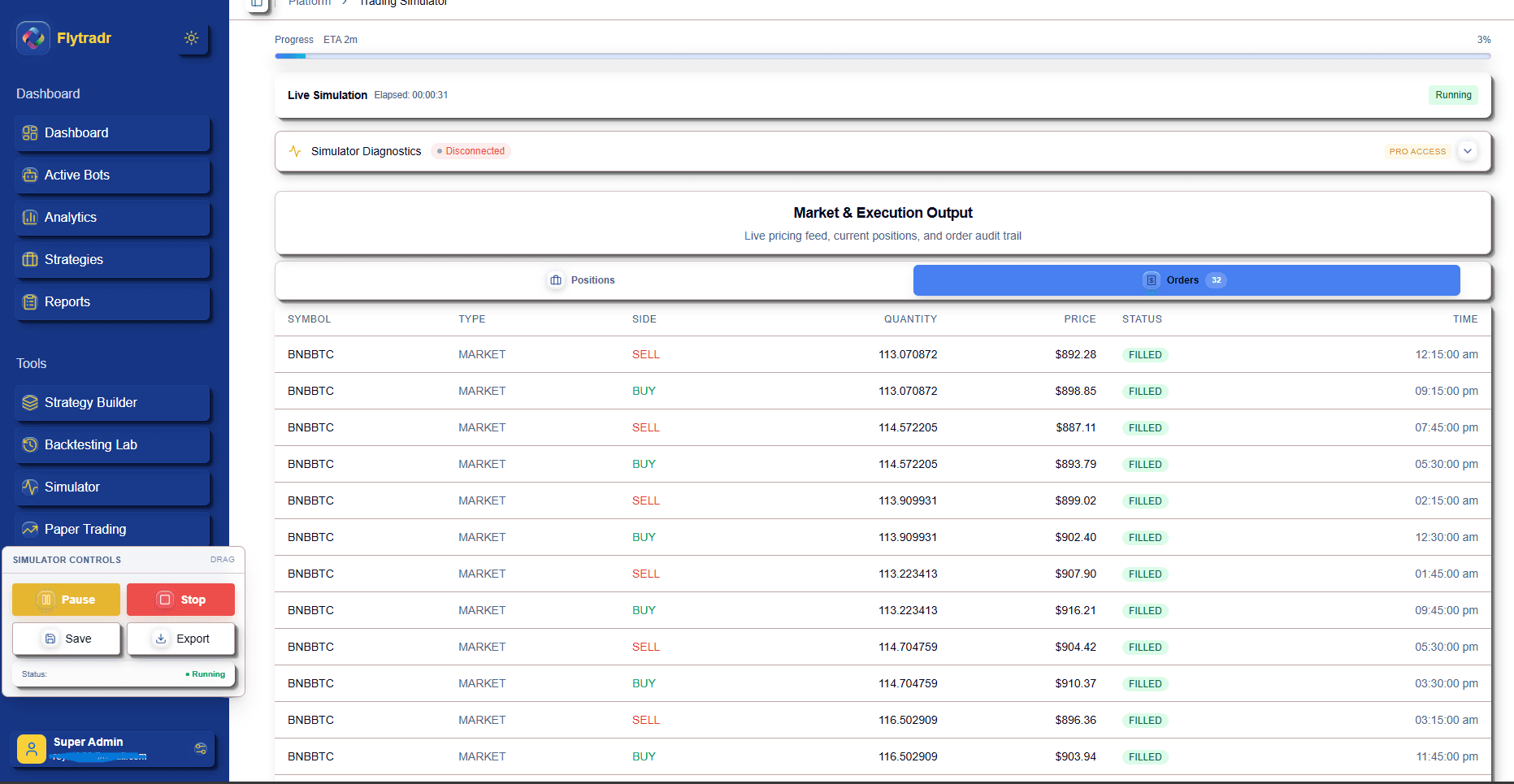
Interactive trading simulator with speed controls for replaying historical market data
What simulation helps you see
- Signal timing: whether entries appear early/late in a move and how often signals flip.
- Execution sensitivity: how slippage and latency assumptions change outcomes.
- Regime brittleness: which market regimes break your logic (chop vs trend vs spikes).
- Operational feel: does the strategy trade too frequently, over-leverage, or cluster risk?
A practical simulation routine
- Pick a period where your backtest drawdown was worst.
- Replay at slow speed and watch entry/exit logic.
- Increase realism (fees, slippage, latency) and observe changes.
- Record what assumptions are required for the strategy to work.
Best for / not for
Best for
- Traders who already have a backtest and want to understand execution behavior in context.
- Users who want to inspect how a strategy reacts during volatility, chop, and regime shifts.
- Retail traders who want a step between backtesting and paper trading.
Not ideal for
- Users who only want final performance summaries without interactive analysis.
- Traders who are already confident enough to skip staged validation.
- Anyone treating simulation output as a guarantee of live results.
Suggested next step
Once simulation behavior looks stable, move to paper trading to validate live-style execution with virtual capital.
Educational note: simulation is a learning tool, not a guarantee of future performance.