

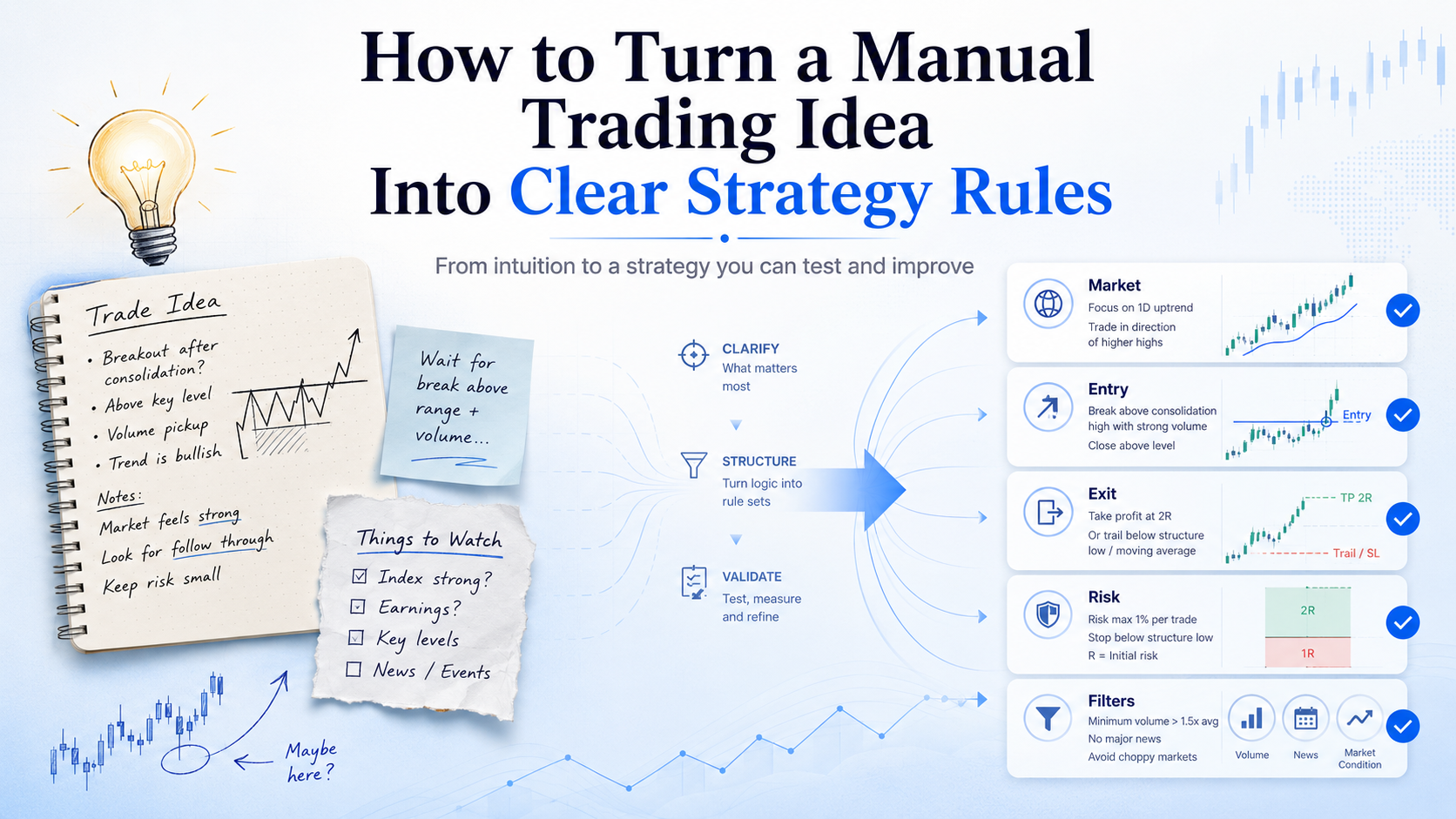
A practical guide for traders who have an idea in their head, but need to turn it into something that can be tested, improved, and eventually automated.
Most traders do not begin with a fully formed strategy; they begin with an observation. A certain setup seems to work well, a price pattern keeps appearing before a move, or a moving average seems useful in one market condition but unreliable in another. Sometimes the idea is even simpler: a feeling that there is an opportunity when price pulls back in a trend, momentum returns after a pause, or volatility expands after a quiet period.
That is a perfectly normal place to start. Many excellent trading systems begin as rough observations from watching charts. The problem occurs when that observation stays vague. A human trader can look at a chart and say the market "looks strong," the move "looks exhausted," or the pullback "looks healthy." A testing engine or automation system cannot work with those descriptions until they are translated into clear, quantifiable rules.
This is where most beginners misunderstand strategy building. They assume the hardest part is coding, automation, or choosing the right tool. In reality, the first challenge is much more basic: you need to know exactly what your strategy is supposed to do before you can test it, automate it, or trust it. A trading idea becomes useful only when it is clear enough that the same decision can be repeated consistently, without changing its meaning on the fly.
This guide details that conversion process. It explains how to take a manual trading idea and turn it into a structured set of rules that can later be tested, reviewed, improved, or automated.
Start With the Trading Idea in Plain English
Before trying to define indicators, timeframes, stop losses, or profit targets, write your idea down in plain English. This first version does not need to be technical. In fact, keeping it simple helps you understand exactly what market anomaly you are trying to capture.
For example, your idea might be:
"I want to buy a stock when it is already in an uptrend and has pulled back to a better entry area."
"I want to trade breakouts only when the market has been consolidating for some time."
"I want to avoid buying when a move is already too extended."
At this stage, the goal is visibility, not perfection. Keeping a strategy in your head makes it far too easy to bend the rules without noticing. One day a setup looks acceptable, the next day the exact same setup is ignored, and you cannot clearly explain why. Writing the idea down forces you to separate the core strategy from the emotion of the moment.
A useful plain-English summary should explain three things: what opportunity you are looking for, what market condition you prefer, and what you want to avoid. Once you can describe those clearly, you can begin building actual rules.
Define the Market, Timeframe, and Direction
A strategy is incomplete until you define its operating environment. The same idea can behave drastically differently across different asset classes, timeframes, and instruments. A rule that seems reasonable on a daily chart may be pure noise on a five-minute chart. A setup that works on liquid, large-cap stocks may fail on thinly traded instruments. Similarly, a crypto strategy that runs 24/7 requires different structural assumptions than a strategy built for regular equity market hours.
The first practical step is to define these boundaries clearly:
Asset Class: Is the strategy meant for stocks, crypto, forex, indices, or commodities?
Timeframe: Is it built for intraday trading, swing trading, or long-term position trading?
Direction: Does the strategy take long trades only, short trades only, or both?
Universe: Should it trade all available symbols or only a filtered group of highly liquid instruments?
These choices stop you from testing the same idea everywhere until you find a random result that looks good—one of the easiest ways to fool yourself in trading. A serious strategy should have a clear intended use before testing begins, not after testing has uncovered a convenient, accidental winner.
A clean starting point looks like this: The strategy is for liquid stocks on the daily timeframe. It takes long trades only, looking for entries in markets that are already trending upward. That simple boundary immediately makes the idea testable.
Convert Visual Judgment Into Measurable Conditions
Manual trading often relies on visual judgment. While not inherently wrong, it becomes a problem when that judgment cannot be measured. Terms like strong trend, clean pullback, weak momentum, support zone, breakout, and overextended move may make sense when looking at a chart, but they require concrete definitions to become a strategy.
The key question to ask is: What exactly must be true for this condition to count?
If you say the market should be in an uptrend, you need to define what an uptrend means for this specific strategy. It could mean price is above a long-term moving average, a shorter moving average is above a longer one, or the market has made a recent higher high. None of these definitions is universally correct, but each one is measurable and testable.
If you say price should pull back, define the parameters of that pullback. Is price retracing to a specific moving average? Has it fallen by a certain percentage from a recent high? Has an indicator like the RSI moved from an overbought reading back to a neutral area? Has price declined for a fixed number of candles?
Your goal is not to describe what looks good in hindsight. You are trying to define what must be visible before the trade is taken. A rule that only makes sense after the move has already happened cannot be trusted.
Separate the Setup, the Trigger, and the Filter
A clear strategy usually has multiple layers. Beginners often combine everything into one vague entry condition, but it is much more effective to divide your logic into three distinct parts:
The Setup: Describes the broader market situation (e.g., the market is in an established upward trend).
The Trigger: Describes the exact, immediate event that pulls you into the trade (e.g., price closes above the previous short-term high after a pullback).
The Filter: Decides whether the trade is allowed at all based on external conditions (e.g., volume must be above a minimum level, or the broader market index cannot be sharply down).
This structure makes the strategy easier to diagnose. Without this separation, traders end up with messy rules. If the strategy performs poorly, they won't know whether the core setup is weak, the entry trigger is lagging, the filter is too restrictive, or the market condition is unsuitable. Separating the logic simplifies future testing and optimization.
Define the Entry Rule Clearly
The entry rule is where the strategy becomes definitive, leaving zero room for interpretation. A good entry rule does not say to buy when the chart "looks strong." It dictates exactly what data must be true at the moment of execution so that two people looking at the same chart would reach the identical conclusion.
For a beginner, this does not need to be complex. A rule can be built from price action, moving averages, volume, volatility, technical indicators, candlestick behavior, or a combination of these.
Weak entry rule: Buy when the price starts recovering from a pullback.
Better entry rule: The market must be above its 200-period moving average, price must retrace to the 20-period moving average, and the entry trigger occurs only when a candle closes above the high of the previous candle.
The purpose of an entry rule is not to guarantee a profitable trade—no rule can do that. Its purpose is to enforce absolute consistency so every trade is judged against the exact same standard.
Define the Exit Before You Judge the Strategy
Many traders obsess over entries because they feel like the exciting part of trading. However, a strategy cannot be fairly evaluated until the exit is equally defined. The exact same entry can produce completely opposite results depending on how the trade is managed and closed.
A strategy that exits quickly at a small profit will behave entirely differently from one that lets winners run. A tight stop loss yields a different win rate and drawdown profile than a wide one.
Because of this, the exit is not a secondary detail; it is the core of the strategy itself. Before testing, you must firmly decide two things:
What invalidates the trade idea? (Your Stop Loss)
What counts as a successful trade? (Your Profit Target)
Your stop loss could be based on a percentage move, a recent swing level, volatility (like ATR), or a technical breakdown. Your profit target could be fixed, based on a specific risk-to-reward ratio, tied to structural resistance, or replaced entirely by a trailing exit to capture larger trends. Whatever you choose, the exit must be written into the rules before you judge performance. Otherwise, you are just guessing.
Add Risk Rules From the Beginning
Risk rules should never be an afterthought added only after a strategy looks profitable. They must be baked into the very first version because position sizing, stop placement, and leverage completely alter a strategy's performance profile.
A strategy with decent entry logic can still wipe out an account if it risks too much capital per trade. Similarly, a strategy that opens too many highly correlated positions can look diversified while actually taking the exact same risk multiple times.
At a minimum, define:
How much capital the strategy will risk on any single trade (e.g., 1% of account equity).
The maximum number of positions that can be open simultaneously.
An equity drawdown trigger at which the strategy should temporarily pause trading.
Good strategy rules do not just ask how much money can be made; they establish exactly how much can be lost before the idea is proven wrong or unsafe.
Define When the Strategy Should Not Trade
A robust strategy needs clear boundaries for when to stay out of the market. This is frequently ignored by beginners who focus entirely on finding more trades, but avoiding poor market regimes is just as vital as finding good entries.
The goal is simply to define the environments where your core logic no longer makes sense:
If your strategy buys pullbacks in an uptrend, it should not trade when the broader market index is in a confirmed downtrend.
If your strategy depends on breakouts, it should remain sidelined during low-volatility, low-volume holiday periods.
If your strategy relies on calm, mean-reversion behavior, it should explicitly avoid major macroeconomic news events.
This does not mean you should add dozens of complicated filters—too many filters lead to over-optimization and curve-fitting. Just outline the clear deal-breakers where the strategy was never designed to operate.
Write the Strategy as a Complete Rule Set
Once all the individual pieces are defined, combine them into one cohesive document. The resulting rule set should be clear enough that an independent third party could read it and execute the strategy exactly as intended.
Strategy Name
Trend Pullback Continuation Strategy
Objective
To identify long entries in highly liquid equities that are in an established upward trend, entering immediately after a minor pullback shows signs of structural continuation.
Market and Timeframe
Liquid stocks on the daily timeframe.
Direction
Long trades only.
Setup Conditions
Trend Condition: Price must be trading above its 200-period simple moving average (SMA).
Pullback Condition: Price must retrace to touch or approach the 20-period SMA without closing below the 200-period SMA.
Entry Trigger
Enter a market order at the next market open after a daily candle closes above the high of the previous day's candle, provided the setup conditions remain valid.
Stop Loss
Place the initial stop loss exactly 1 tick below the recent local swing low of the pullback.
Profit Management & Exits
Exit the entire position if a daily candle closes below the 20-period SMA, or if the initial stop loss is triggered.
Risk Rules
Risk exactly 1% of total account capital per trade, calculating position size based on the distance between the entry price and the initial stop loss. Maximum of 5 open positions at any time.
Avoidance Rules
Do not take new entries if the broader market index (e.g., S&P 500) is trading below its own 200-period SMA, or if the individual stock has an upcoming earnings announcement within the next 3 days.
Test the First Version Before Improving It
Once your first rule set is drafted, resist the temptation to immediately add more variables. The next step is to test this baseline version to understand its raw behaviour.
Many traders make the mistake of trying to solve every potential weakness before running a single test. They stack indicators, exceptions, and special conditions until the strategy becomes a black box. A complicated strategy might feel more sophisticated, but it is incredibly difficult to trust because you cannot tell which part is genuinely helping and which part is simply making the historical data look pretty.
Keep the first version simple enough to explain in a few sentences. Once you test it, you can accurately diagnose its structural flaws: Is the entry trigger too late? Is the stop loss too tight? Does the exit give back too much profit? Does the filter eliminate too many winning trades?
Testing is not just about finding a net profit figure; it is about analyzing behaviour, drawdowns, and trade distribution under different market regimes.
Keep a Strategy Change Log
As you refine and optimize your strategy, maintain a written record of every single modification. Document exactly what you changed, why you changed it, and the quantifiable effect it had on your testing results.
Without a change log, strategy development quickly devolves into an emotional guessing game. After a few consecutive losses, you will feel compelled to widen your stops. After a missed winning trade, you will want to loosen your entry criteria.
A change log enforces institutional discipline. It forces you to verify whether an adjustment is backed by data or driven by the recency bias of a bad trade. The goal of development is not to create a set of rules that perfectly explains the past, but to build a framework robust enough to survive the uncertainty of the future.
Final Thoughts
Converting a manual trading idea into clear strategy rules is not about removing human intelligence from the process; it is about making your ideas specific enough to be honestly evaluated. As long as a strategy remains vague, it is easy to look at a chart and trick yourself into believing it works. Once the rules are explicitly written down, the strategy has to stand on its own data.
This process also strips the mystery away from automation. Before a strategy can ever be coded into an algorithm, it must be defined. A computer does not need a brilliant intuition; it needs precise, binary instructions. It must know exactly when a setup is valid, when to enter, when to exit, how much capital to allocate, and when to stay flat.
For any developing trader, this is the real starting point. Do not worry about engineering the perfect system on day one. Take a single observation, get it out of your head, and write it down clearly enough to be measured. Once you have defined the environment, the setup, the trigger, the exit, and the risk rules, you no longer just have an idea—you have a strategy.
Comments
Ask a question or leave feedback. Guests can post too.
Max 2000 characters.
No comments yet.
Quick answers
What is this article about?
Before you can code or automate a trading strategy, you must define it.
Who should read this article on How to Turn a Manual Trading Idea Into Clear Strategy Rules?
This article is for retail traders who want a practical understanding of how to turn a manual trading idea into clear strategy rules before moving into backtesting, simulation, paper trading, or broker-connected execution.
What should I do after reading this article?
Use the article to clarify the concept first, then review FlyTradr workflow pages such as the algo trading platform overview, methodology and assumptions, or the FAQs page before making a platform decision.