

Algo Trading on Indian Equity Markets: What Retail Traders Need to Know in 2026
In September 2024, SEBI dropped a bombshell: 93% of individual traders in equity F&O lost money between FY22 and FY24. We’re talking about an aggregate loss of ₹1.8 lakh crore.
But here’s the kicker: those losses weren't usually because the "idea" was bad. They happened because humans are bad at being robots. We hesitate on entries, we panic-sell exits, and we "revenge trade" when we're down.
Algorithmic trading doesn't fix a bad strategy, but it does fix a bad trader. It enforces the discipline that the 93% are missing. If you’re ready to stop trading on "vibes" and start trading on data, here is the updated 2026 roadmap for the Indian retail landscape.
1. The Legal Reality: Is it Legal in 2026?
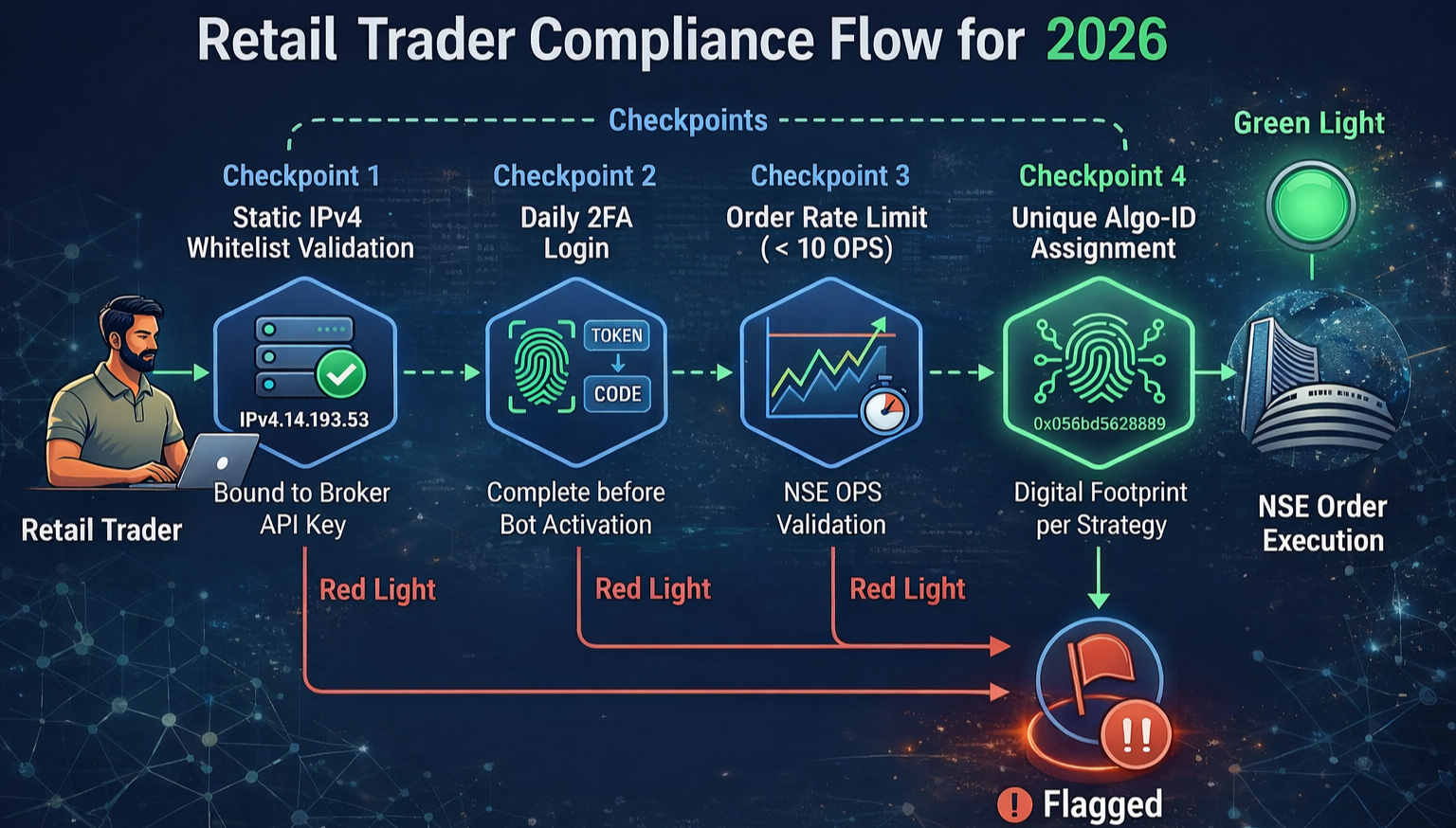
Yes, but the rules just got stricter as of April 1, 2026. For years, retail algo was a "grey-ish" area. Now, SEBI has brought it into the light with a clear framework. Here’s what you need to know to stay compliant:
The 10 OPS Rule: If your script fires fewer than 10 Orders Per Second (OPS), you are a "regular API user." You don't need formal exchange registration. Most retail traders fall here.
The Static IP Mandate: This is the big change. You can no longer fire API orders from a dynamic home IP or a random coffee shop Wi-Fi. Your broker now requires your API key to be bound to a Whitelisted Static IPv4 address.
Unique Strategy IDs: Every automated order now carries a digital fingerprint (Algo-ID). This allows exchanges to trace anomalies back to the source.
Daily 2FA: Continuous "refresh-token" sessions are dead. You must complete 2FA once every trading day before your bot can start firing.
The Golden Rule: Stick to official broker APIs (Kite Connect, SmartAPI, etc.). Using unofficial "browser automation" tools that mimic clicks is a fast track to getting your account flagged.
2. Choosing Your "Pipe": The 2026 Broker Landscape
The "API Tax" has plummeted, making it easier than ever to start.
Broker | API Cost (2026) | Best For... |
Zerodha | Order API: Free | The gold standard for documentation and community support. |
Dhan | Free / Competitive | Best-in-class developer experience and modern tech stack. |
Angel One | Free | The lowest barrier to entry for beginners. |
Fyers | Free | Stability and specialized features for options traders. |
Pro-Tip: Don’t just look at the cost. Check the Rate Limits. If your strategy needs to poll 50 stocks simultaneously, ensure your broker’s API can handle the load without "throttling" you during high volatility.
3. The Capital Conversation (and the "Tax Toll")
You don't need a fortune, but you do need to understand the Budget 2026 STT Hike.
₹50,000 – ₹1,00,000: Your "Tuition Fee." Use this to test your API connection, handle your Static IP setup, and see how your logic behaves in a live market.
₹2,00,000+: This is where the math starts working in your favor.
The Reality Check on Costs: As of April 1, 2026, the cost of trading F&O has jumped significantly. While Equity Intraday (0.025%) remains unchanged, Equity Futures (Sell) STT has jumped to 0.05%, and Options (Sell) premium STT is now 0.15%.
Before you go live, your backtest must account for:
STT & GST (Which can now be 2-3x higher than your brokerage).
Slippage (The difference between your "theoretical" price and the actual fill).
Static IP Costs (Usually ₹200-₹500/mo from your ISP or cloud provider).
4. What Actually Works on the NSE?
Forget High-Frequency Trading (HFT). You cannot outrun a co-located server in Mumbai. Instead, focus on:
Trend Following: Indian mid-caps love to trend. Moving average crossovers or Supertrend-based systems are classic for a reason—they capture the "meat" of a move.
Mean Reversion: When Nifty 50 stocks get overextended (RSI > 80 or < 20), they often snap back. These are easier to automate than to trade manually, where fear usually stops you from "buying the dip."
The Overfitting Trap: If your backtest shows a 90% win rate and a straight line up, it’s probably a lie. You’ve "overfit" your strategy to the past. Always test your strategy on "Out-of-Sample" data—a time period the bot has never seen before.
How FlyTradr Bridges the Gap
We built FlyTradr specifically for the 2026 Indian market. You don't need to be a Python expert or worry about managing a Static IP server.
No-Code Builder: Define your logic (e.g., "Buy when Nifty 50 RSI crosses 30") visually.
2026-Ready Backtesting: Our engine automatically factors in the new STT rates and transaction fees, so your "profit" number is actually what ends up in your bank account.
Automated Hosting: We handle the compliant hosting and Static IP requirements, so you can focus on the strategy, not the infrastructure.
Ready to stop being part of the 93%?
[Build and test your first systematic strategy on FlyTradr—Free to start.]
Key Takeaways for the "Skimmers"
It's Legal: Retail algo is SEBI-approved, but you must use a Static IP as of April 2026.
Costs are Down: Zerodha’s order API is now free; starting costs have never been lower.
The "Tax Toll" is Up: Budget 2026 increased STT on F&O. High-frequency retail strategies are harder to make profitable now.
Test, then Test Again: Use paper trading to ensure your "perfect" backtest survives the reality of slippage and market noise.
Comments
Ask a question or leave feedback. Guests can post too.
Max 2000 characters.
No comments yet.
Quick answers
What is this article about?
India now has over 17 crore demat accounts — but SEBI data shows 93% of active F&O traders still lose money.
Who should read this article on Algo Trading on Indian Equity Markets: What Retail Traders Need to Know Before Starting?
This article is for retail traders who want a practical understanding of algo trading on indian equity markets: what retail traders need to know before starting before moving into backtesting, simulation, paper trading, or broker-connected execution.
What should I do after reading this article?
Use the article to clarify the concept first, then review FlyTradr workflow pages such as the algo trading platform overview, methodology and assumptions, or the FAQs page before making a platform decision.