

How to Use VWAP Strategies Systematically
VWAP is an abbreviation that gets used frequently in trading discussions, but the underlying concept is simpler than it sounds, and it has genuine practical application for systematic intraday traders.
This guide explains what VWAP actually measures, why institutional traders pay attention to it, and how to build systematic strategies around VWAP levels on Indian equity markets.
What VWAP Is and How It Is Calculated
VWAP stands for Volume Weighted Average Price. It is the average price at which a security has traded throughout a session, weighted by the volume traded at each price level.
The calculation works as follows. For each time interval during the session, multiply the price at which trades occurred by the volume of those trades. Sum all of these values over the session so far. Divide by the total volume traded so far in the session.
The result is a running average price that reflects not just where the price has been, but how much volume was associated with each price level. A large-volume trade at 500 rupees will affect the VWAP more than a small-volume trade at 520 rupees.
VWAP resets at the start of each trading session. It is an intraday indicator, not a multi-day one. On Indian equity markets, VWAP starts fresh at 9:15am each morning and reflects the cumulative volume-weighted activity from session open.
Why VWAP Matters: The Institutional Perspective
To understand why VWAP works as a reference level, you need to understand how large institutional orders are executed.
When a fund manager wants to buy a large position in a stock, they cannot simply place a single large order. A single large market order would push the price up significantly before it could all be filled, meaning they would end up paying more than they needed to.
Instead, institutional traders typically break large orders into smaller pieces and execute them throughout the session. Their benchmark for whether they executed well is VWAP. If the average price they paid across all their smaller orders is below the day's VWAP, they outperformed the benchmark. If they paid above VWAP, they underperformed.
This creates a self-reinforcing dynamic. Institutions are actively trying to buy at or below VWAP and sell at or above VWAP. This means VWAP tends to act as a meaningful support and resistance level throughout the trading session, because large players are anchoring their execution around it.
How Retail Traders Use VWAP
For individual systematic traders, VWAP is useful in two main ways.
As a trend indicator within the session: when price is consistently above VWAP, the session has an upward bias and most activity is happening at prices above the volume-weighted average. When price is consistently below VWAP, the session has a downward bias.
As a dynamic support and resistance level: price often gravitates back toward VWAP after moving away from it, and VWAP can act as support on the way up or resistance on the way down during different points in the session.
Building a VWAP Mean Reversion Strategy
One common systematic approach is to trade mean reversion toward VWAP.
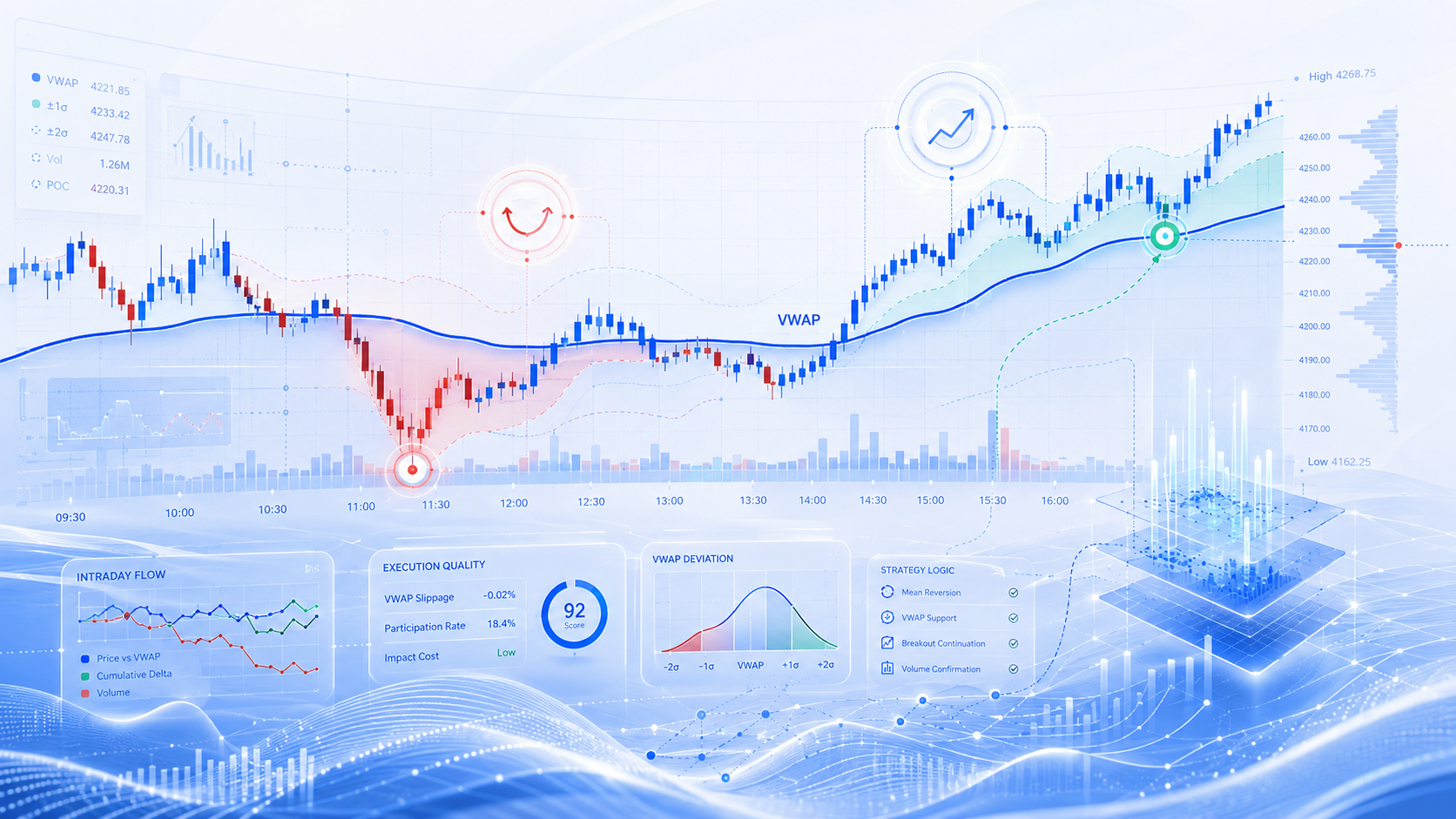
Entry condition for a long: price has moved significantly below VWAP, by a defined threshold, and begins to show signs of moving back toward it. You are entering with the expectation that price will return to the volume-weighted average.
Entry condition for a short: price has moved significantly above VWAP and begins to reverse back toward it.
The challenge in this approach is defining "significantly." One method is to use the standard deviation of price from VWAP as the threshold. Some platforms provide VWAP with bands, similar to Bollinger Bands, that show one or two standard deviations above and below the VWAP line. A price touch of the two-standard-deviation band is a more extreme deviation than a one-standard-deviation touch.
Exit condition: price returns to VWAP.
Stop loss: placed beyond the extreme of the move, or at a defined distance based on ATR.
This strategy works best in sessions where the overall market is range-bound. In strongly trending sessions, mean reversion to VWAP can fail repeatedly as price moves consistently away from VWAP in one direction.
Building a VWAP Breakout Strategy
An alternative approach is to use VWAP as a trend confirmation.
In this framework, you are not trying to trade the return to VWAP. You are using VWAP as a filter to determine which direction to trade.
Long condition: price is above VWAP and makes a new session high. This confirms upward momentum with institutional support and you enter long.
Short condition: price is below VWAP and makes a new session low. This confirms downward momentum.
Exit condition: end of session, or a defined price target, or when price crosses back through VWAP in the opposite direction.
This approach aligns with the institutional flow. You are trading in the direction that institutional participants are likely to be executing their orders, which gives your trade the benefit of that demand or supply flow.
Important Constraints for VWAP Strategies
VWAP strategies are inherently intraday. Because VWAP resets at the start of each session, positions are typically closed at session end. This makes VWAP strategies unsuitable for traders who want to hold positions overnight.
Session timing matters. VWAP is most meaningful during the core trading hours of the session. In the first 15 to 30 minutes of the Indian equity session, VWAP is being established on relatively low cumulative volume and is more volatile. The VWAP level becomes more stable and meaningful as the session progresses and more volume accumulates.
Some systematic traders avoid the first 30 minutes of the session specifically to let VWAP stabilise before using it as a reference level.
Instrument selection is important. VWAP works best on liquid instruments where institutional participation is significant. Nifty 50 stocks and Nifty index futures are well-suited to VWAP strategies because institutional flow is heavy and the volume-weighted benchmark is genuinely used by large participants. Illiquid stocks may have VWAP levels that do not reflect meaningful institutional activity.
Backtesting VWAP Strategies
Backtesting VWAP strategies requires intraday data, typically at 5-minute or 15-minute intervals, because VWAP itself is an intraday calculation.
Key metrics to evaluate:
Win rate and average win versus average loss. A mean reversion strategy around VWAP typically has a decent win rate but can have larger individual losses when VWAP fails as a level in trending sessions.
Performance by session type. Examine whether the strategy performs differently in clearly trending sessions versus ranging sessions. Most VWAP strategies have a pronounced difference between these conditions.
Time-of-day effects. Does the strategy perform better in the morning session, around midday, or in the afternoon? Many intraday strategies have distinct time-of-day performance patterns worth understanding.
A Starting Point for VWAP Strategy Development
If you are new to VWAP strategies, a straightforward starting approach is the following.
Use a liquid Nifty 50 stock or the Nifty index itself. Start 30 to 45 minutes after session open to let VWAP stabilise. Look for a clear deviation from VWAP, either a price significantly above or below it. Enter when price begins to move back toward VWAP. Exit when price reaches VWAP. Use a stop loss placed at the extreme of the deviation.
Backtest this on at least six months of intraday data before paper trading it. Pay close attention to the losing trades: what was different about the sessions where price continued away from VWAP instead of reverting?
The answers to those questions are what separates a rough starting idea from a strategy worth trading.
Remember VWAP is not a strategy by itself. It is a reference point. The edge comes from defining when price is stretched, when it is confirming direction, when the setup should be ignored, and how the idea performs across different session types.
FlyTradr supports intraday strategy building with VWAP as an available indicator in the no-code Strategy Builder. You can build and backtest VWAP-based strategies against historical intraday data without writing any code. Explore the Strategy Builder here.
Comments
Ask a question or leave feedback. Guests can post too.
Max 2000 characters.
No comments yet.
Quick answers
What is this article about?
VWAP is one of the most widely used intraday benchmarks in institutional and retail trading.
Who should read this article on VWAP Strategies for Intraday Traders: How to Use It Systematically?
This article is for retail traders who want a practical understanding of vwap strategies for intraday traders: how to use it systematically before moving into backtesting, simulation, paper trading, or broker-connected execution.
What should I do after reading this article?
Use the article to clarify the concept first, then review FlyTradr workflow pages such as the algo trading platform overview, methodology and assumptions, or the FAQs page before making a platform decision.