

Paper Trading vs Live Trading: Why Your Results Will Always Differ
Paper trading is the step between backtesting and live trading. You run your strategy in real market conditions, with real prices and real market hours, but without any actual money at risk. It is a genuinely useful tool, and it should be a required step in any systematic trader's validation process.
But paper trading will never perfectly replicate live trading performance. The gap between the two is real, consistent, and predictable. Understanding what causes it helps you use paper trading more effectively and enter live trading with more realistic expectations.
What Paper Trading Actually Tests
Before explaining why results differ, it is worth being clear about what paper trading does test.
It tests your strategy logic in real market conditions. Unlike a backtest, which runs on historical data, paper trading uses live prices and live market hours. Your entry and exit signals fire at the same time they would fire in live trading. This reveals timing issues, session boundary behaviour, and signal conditions that may not have been fully captured in your backtest.
It tests your monitoring and operational setup. Running a paper trading session forces you to have your infrastructure working, with the platform connected, the strategy running, and notifications in place. Any operational problems that would affect live trading can surface during paper trading.
It tests your psychological relationship with drawdowns. Even though no real money is at stake, watching your paper portfolio lose value produces a meaningful emotional response for most traders. This is useful data about how you may behave when the same drawdown happens in live trading.
What paper trading does not fully test is where the performance gap usually comes from.
The Main Reasons Paper Trading and Live Trading Diverge
Order Execution and Slippage
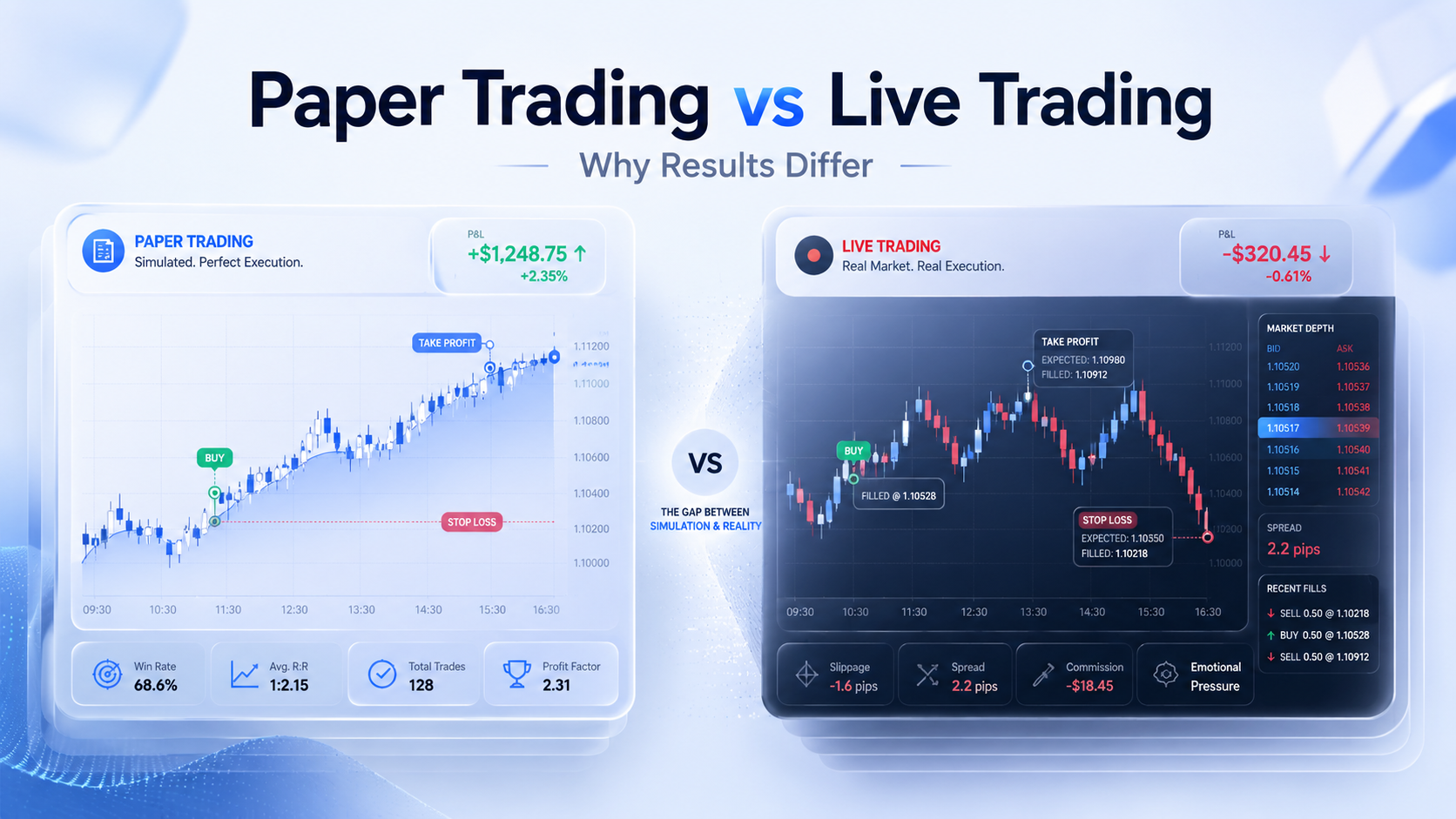
In paper trading, your orders typically fill at the quoted price the moment your signal fires. In live trading, actual execution depends on available liquidity, the speed of your connection to the broker, and the state of the order book at the moment your order arrives.
For large, liquid instruments, the difference between the paper price and the live execution price is usually small. For smaller, less liquid instruments, the gap can be meaningful. Your paper trading results reflect the price you intended to trade at. Your live trading results reflect the price you actually received.
This is called slippage, and it is consistently worse in live trading than in paper trading. A strategy that looked marginally profitable on paper can become marginally unprofitable in live trading if slippage on each trade is large enough.
Bid-Ask Spread
Related to slippage is the bid-ask spread. When you buy in live trading, you typically pay the ask price, which is slightly above the mid-price. When you sell, you receive the bid price, which is slightly below the mid-price. This spread is a real cost that paper trading often does not fully account for.
On highly liquid instruments like Nifty 50 large-cap stocks, the bid-ask spread may be only a few paise, so the impact is minimal. On less liquid instruments, the spread can be wider, and the cumulative cost across many trades can add up.
Partial Fills and Order Rejections
In paper trading, your order usually fills completely at the intended price. In live trading, a market order for a large quantity may fill partially across multiple price levels. A limit order may not fill at all if the price moves away before your order can be matched.
For a systematic strategy that assumes complete fills, partial fills in live trading create position sizes that do not match the intended size, which affects both risk management and performance.
Latency
Paper trading systems do not perfectly simulate the latency between your signal being generated, your order being placed, and the order being executed. In live trading, there is always a delay between the signal and the execution. In fast-moving markets, even a small delay can result in a meaningfully different entry price.
For strategies that trade on longer timeframes, such as daily charts or swing strategies, this latency is usually less important. For faster intraday strategies, the difference in latency between paper and live trading can materially affect results.
Psychological Factors
This is the difference that is hardest to quantify, but often the most significant.
When no real money is at stake, you follow your strategy rules precisely. You do not override the exit signal because you think the trade might recover. You do not skip an entry signal because you are nervous about the market. You simply let the system run.
When real money is at stake, the psychological experience changes. A drawdown that was easy to observe during paper trading becomes stressful when it represents real money. The temptation to intervene, switch the strategy off during a bad run, or override a signal based on intuition is much stronger in live trading.
This behavioural gap is not a character flaw. It is a normal human response to financial risk. Knowing it will happen allows you to plan for it.
Using Paper Trading More Effectively
Given that paper trading results will not match live trading results, the goal is to use paper trading in a way that maximises its value as a validation tool.
Run paper trading for long enough to observe multiple losing periods. A paper trading run of two to three weeks that only captures a positive period tells you very little. You want to see how the strategy behaves through different conditions, including drawdowns, before going live.
Treat paper trades as if they are real. Make decisions about your paper trades the same way you would make decisions about live trades. If you would not intervene in a live strategy, do not intervene in the paper strategy. The psychological value of paper trading comes partly from practising the discipline of following your rules.
Keep detailed records. Note not just the overall performance, but also the individual trades, the conditions when they were taken, and any points where you felt the urge to intervene. This builds self-knowledge that will be useful in live trading.
Apply a discount to your paper trading results when projecting live performance. A reasonable assumption is that your live trading results will be worse than your paper trading results due to slippage, spreads, and the psychological factors discussed above. If your paper strategy returns 10 percent annualised, plan for live performance to be lower before deciding whether to go live.
Closing the Gap Between Paper and Live
Some of the gap between paper and live trading can be reduced by improving your paper trading setup.
Configure your paper trading system to assume a realistic bid-ask spread and slippage on each trade. Some platforms allow you to add a slippage assumption to your paper orders. Using a figure based on the historical average spread and market impact for the instruments you are trading gives you a more realistic simulation.
Use limit orders rather than market orders where possible. Limit orders give you more control over your execution price and reduce the risk of paying an unusually wide spread during volatile moments.
Start with smaller position sizes when first going live. Running your strategy at 25 to 50 percent of your intended position size for the first four to six weeks of live trading reduces your financial exposure while you validate that the live execution matches your expectations.
The transition from paper to live trading is a genuine milestone. Understanding the sources of the performance gap allows you to cross it with more realistic expectations and better preparation.
FlyTradr's Paper Trader runs your strategy in real market conditions with real prices and real session timing, giving you a genuine simulation of live trading behaviour before you commit real capital. Explore the Paper Trader here.
Comments
Ask a question or leave feedback. Guests can post too.
Max 2000 characters.
No comments yet.
Quick answers
What is this article about?
Paper trading is a critical step before going live with any automated strategy.
Who should read this article on Paper Trading vs Live Trading: Why Your Results Will Always Differ?
This article is for retail traders who want a practical understanding of paper trading vs live trading: why your results will always differ before moving into backtesting, simulation, paper trading, or broker-connected execution.
What should I do after reading this article?
Use the article to clarify the concept first, then review FlyTradr workflow pages such as the algo trading platform overview, methodology and assumptions, or the FAQs page before making a platform decision.