

Beginners should treat algorithmic trading as a structured learning process, not a shortcut to automation. The real first step is turning a trading idea into clear rules, then validating those rules through backtesting, simulation, and paper trading.
Most beginners think algorithmic trading starts with code. It usually should not. It should start with rule clarity. If you cannot explain your entry, exit, and risk logic in simple terms, automating it will only make the confusion run faster.
The first useful milestone is not a sophisticated system. It is a simple strategy that you can describe, test honestly, and review without guessing what actually happened.
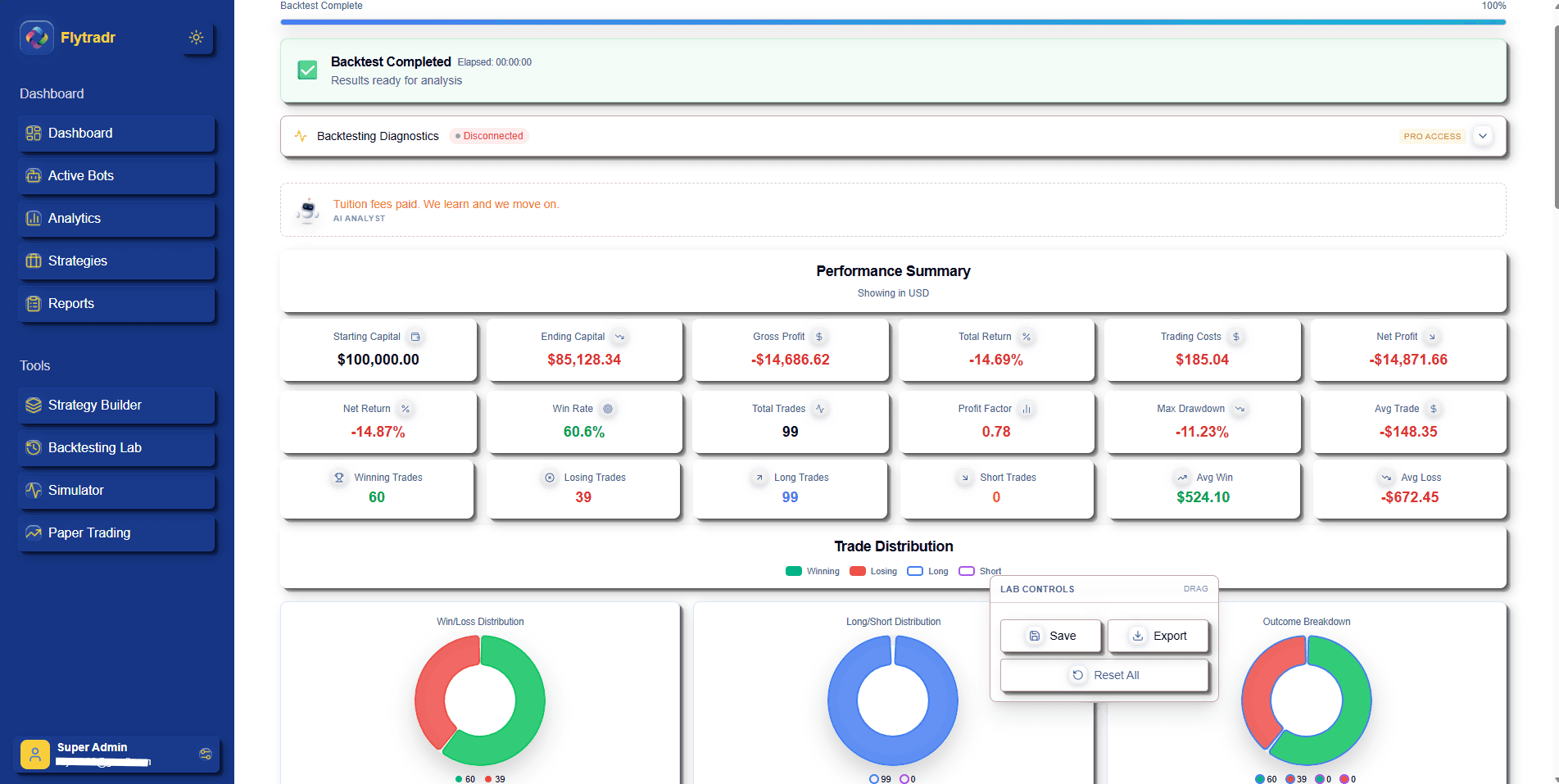
Beginners improve faster when they can inspect logic, risk, and trade behavior rather than just stare at P and L.
What beginners should focus on first
- Understanding what algorithmic trading actually means.
- Learning to express a strategy as explicit rules.
- Knowing the difference between idea quality and execution quality.
- Testing with realistic assumptions instead of perfect historical fills.
- Building a habit of staged validation before live risk.
A good beginner workflow
- Start with one simple setup, not ten indicators.
- Turn that setup into rules with a no-code strategy workflow.
- Run a backtest to see how it behaved historically.
- Use a simulator to inspect difficult periods more closely.
- Paper trade before considering any live workflow.
Common beginner mistakes
- Choosing complexity before understanding basics.
- Chasing the best looking backtest instead of the most understandable strategy.
- Ignoring fees, slippage, latency, and market regime changes.
- Assuming a tool can remove the need for judgment and discipline.
- Going live too quickly after one encouraging result.
Why a no-code start can make sense
For beginners, no-code is not about avoiding rigor. It is about reducing unnecessary technical friction while learning the core workflow. If the goal is to learn how to think in rules, test honestly, and review risk, then a no-code path can be the fastest clean starting point.
FlyTradr is built around that staged workflow. It helps beginners go from rule creation into backtesting, simulation, and paper trading without pretending that one backtest is enough proof.
Educational note: this page is for learning and workflow clarity. It is not investment advice.
Who this beginner path fits best
Best for
- Retail traders who are new to structured strategy design.
- Beginners who want to learn the workflow before learning code.
- Users who prefer a staged build, test, simulate, and paper trade path.
Not ideal for
- Anyone looking for instant automation without understanding the logic.
- Users who want to skip validation and go live quickly.
- Teams that already know they need a code-first research stack.
Related pages
What is algorithmic trading
Core definition and category explainer.
No-code algo trading
How beginners can structure strategies without coding first.
Algo trading platform
See the full FlyTradr workflow.
Best algo trading platforms in India
When you are ready to compare platforms.
How FlyTradr works
The full staged workflow explained.