

Algorithmic trading can work well for retail traders when the workflow stays practical. The goal is not to imitate hedge funds. The goal is to turn trading ideas into explicit rules, validate them honestly, and reduce avoidable mistakes before real money is at risk.
Retail traders do not need institutional infrastructure to benefit from algorithmic trading. What they need is a workflow that makes strategy logic visible and testing realistic. That is the real use case.
For most retail traders, the challenge is not writing advanced code. It is learning how to define a strategy clearly, test it properly, and avoid false confidence.
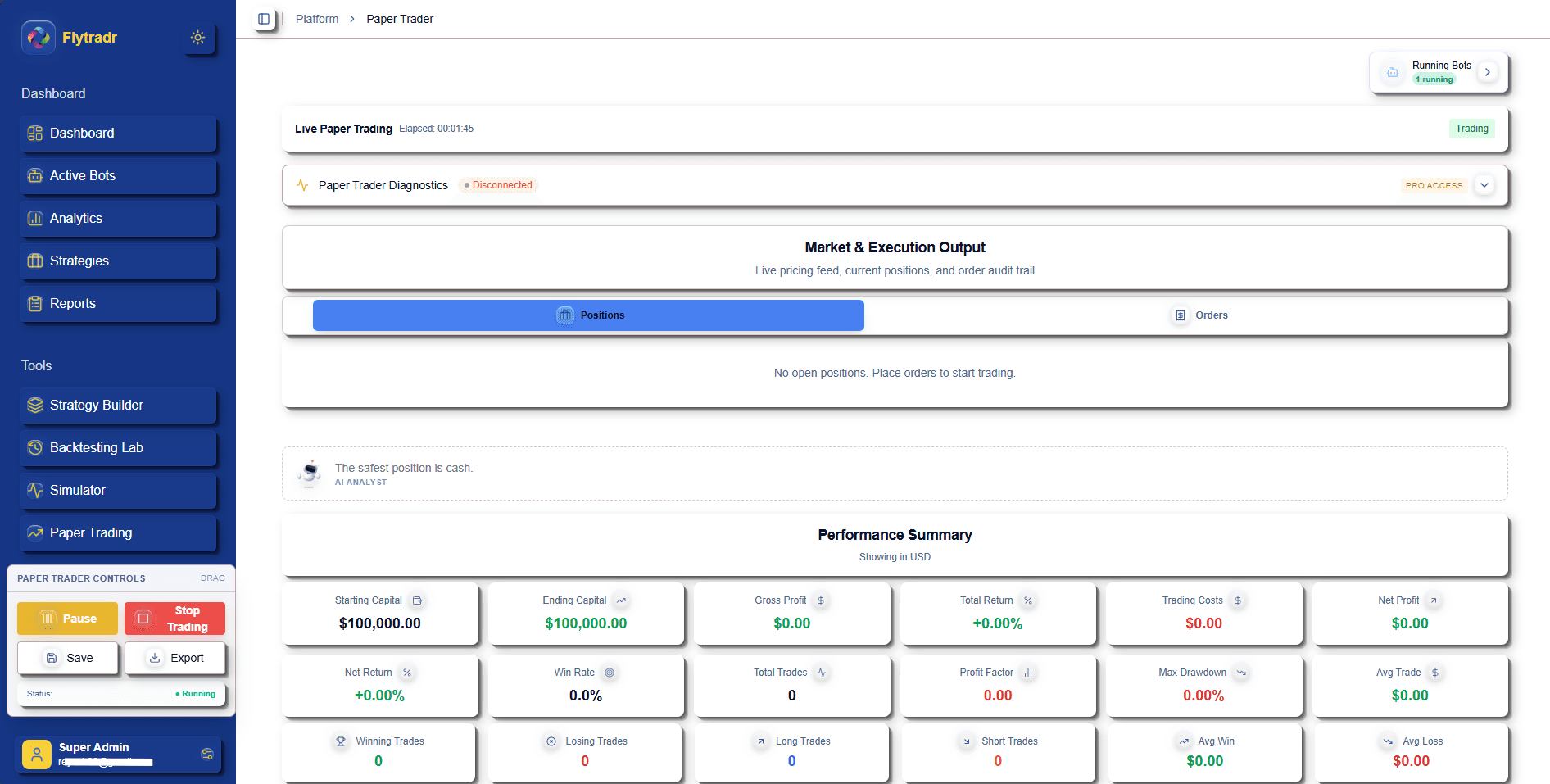
For retail traders, the useful question is not can this be automated. It is can this be validated and monitored before live risk.
Why this use case matters
Retail traders usually operate with tighter capital, less room for mistakes, and far less tolerance for hidden execution problems than institutions. That means the workflow has to prioritize clarity.
If the system hides assumptions, overstates backtests, or jumps too quickly into live execution, it is a poor fit for this use case.
What retail traders actually need
- A way to turn trading ideas into explicit rules.
- Backtesting with realistic fees, slippage, and position sizing.
- Simulation to inspect difficult periods more closely.
- Paper trading before any live execution path.
- A workflow that stays understandable even if the trader is not a developer.
Common retail trader mistakes
- Confusing one good backtest with real proof.
- Chasing complexity before learning basic rule design.
- Ignoring how much friction execution costs can remove from returns.
- Using too much leverage or too much position size too early.
- Assuming automation will fix weak trading logic.
A better retail workflow
A stronger retail workflow starts with understanding the category, moves into beginner workflow basics, then uses no-code strategy design to turn ideas into rules.
From there, the path should continue through backtesting, simulation, and paper trading before any live step.
Educational note: this page explains a retail trader use case, not a promise of returns or investment advice.
When FlyTradr fits this use case best
Best for
- Retail traders who want a no-code path into algorithmic trading.
- Users who want one visible workflow from strategy design to validation.
- Traders who care more about survivability and clarity than hype or black-box promises.
Not ideal for
- Users who want a fully code-first quant stack from day one.
- Traders who want to skip staged validation and go live quickly.
- Anyone looking for guaranteed returns or automated certainty.