

Algorithmic trading is the process of using predefined rules to generate and manage trades. The goal is not magic automation. The goal is more consistent decision-making.
In manual trading, every decision depends on what you notice in the moment. In algorithmic trading, the logic is defined first. That logic can then be tested, replayed, and improved in a more repeatable way.
This matters because it turns vague ideas into explicit rules that can be inspected. A good retail workflow is less about automation hype and more about making the process visible.
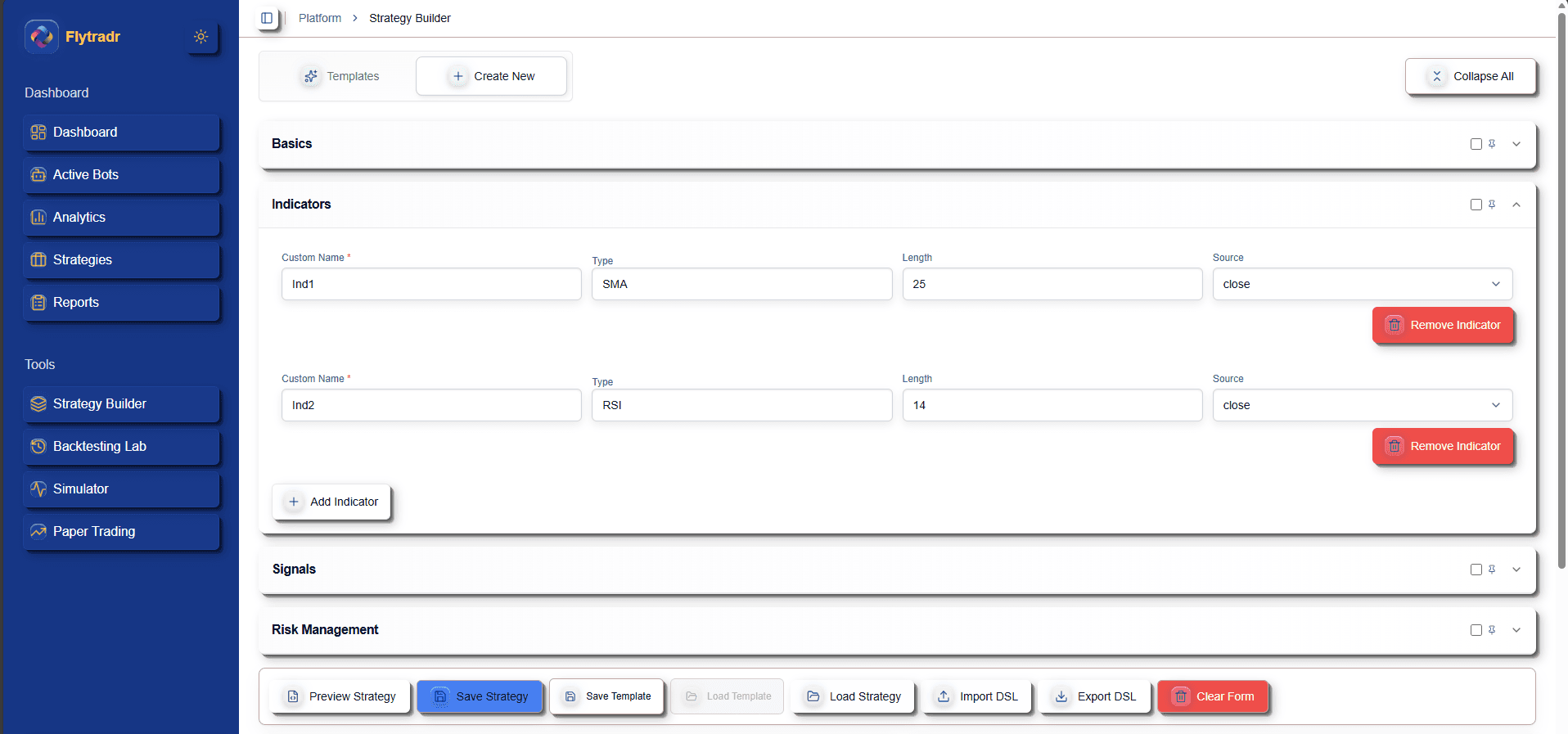
A visual strategy builder can help beginners define algorithmic trading rules without starting from code.
How algorithmic trading works
- You define a set of conditions for entries, exits, and risk management.
- You test those rules on historical market data with a backtesting workflow.
- You inspect whether the results are stable or only look good in one narrow period.
- You replay or simulate the strategy to understand behavior in more detail.
- You paper trade before moving toward any live execution.
What makes up an algorithmic trading strategy
- Entry rules: what must happen before a trade is opened.
- Exit rules: how and when the trade is closed.
- Position sizing: how much capital is allocated to each trade.
- Risk controls: stop loss, exposure limits, and guardrails.
- Execution assumptions: fees, slippage, and latency.
Common examples and common mistakes
- Trend following: buying when a trend strengthens and exiting when it weakens.
- Mean reversion: betting that price moves return toward an average.
- Breakout strategies: reacting when price moves outside an important range.
- Filter-based systems: trading only when volatility, volume, or higher timeframe conditions agree.
The biggest trap is thinking automation removes uncertainty. It does not. A weak strategy stays weak after automation. Another common mistake is trusting a good-looking backtest without checking whether the rules are overfitted or whether friction was ignored.
- Ignoring fees and slippage.
- Optimizing too much for the past.
- Using too many conditions without understanding them.
- Skipping simulation or paper trading.
- Assuming a backtest is proof of future returns.
Beginners do not need to start with Python or a brokerage API. A better first step is learning how to express a strategy clearly, test it honestly, and pressure-test it across different conditions.
Who should start with a no-code workflow
Best for
- Retail traders who want to turn a trading idea into explicit rules.
- Beginners who want to learn the workflow before committing to code-heavy tools.
- Traders who want one path from building into backtesting, simulation, and paper trading.
Not ideal for
- Anyone looking for guaranteed profits or financial promises.
- Users who want to skip testing and jump straight into live execution.
- Teams that specifically need a code-first quant research stack from day one.
Related pages
Algorithmic trading for beginners
A practical starting path for beginners.
Algo trading platform
See the full FlyTradr workflow.
No-code algo trading
Learn how beginners can start without coding.
FlyTradr AI
See the bounded AI assistance that supports—not replaces—your review and validation.
Backtesting software
Understand historical validation.
How FlyTradr works
See the staged build-to-validation model.