

Multi-Timeframe Trading Strategies: How to Avoid Mismatched Signals and Hidden Bias
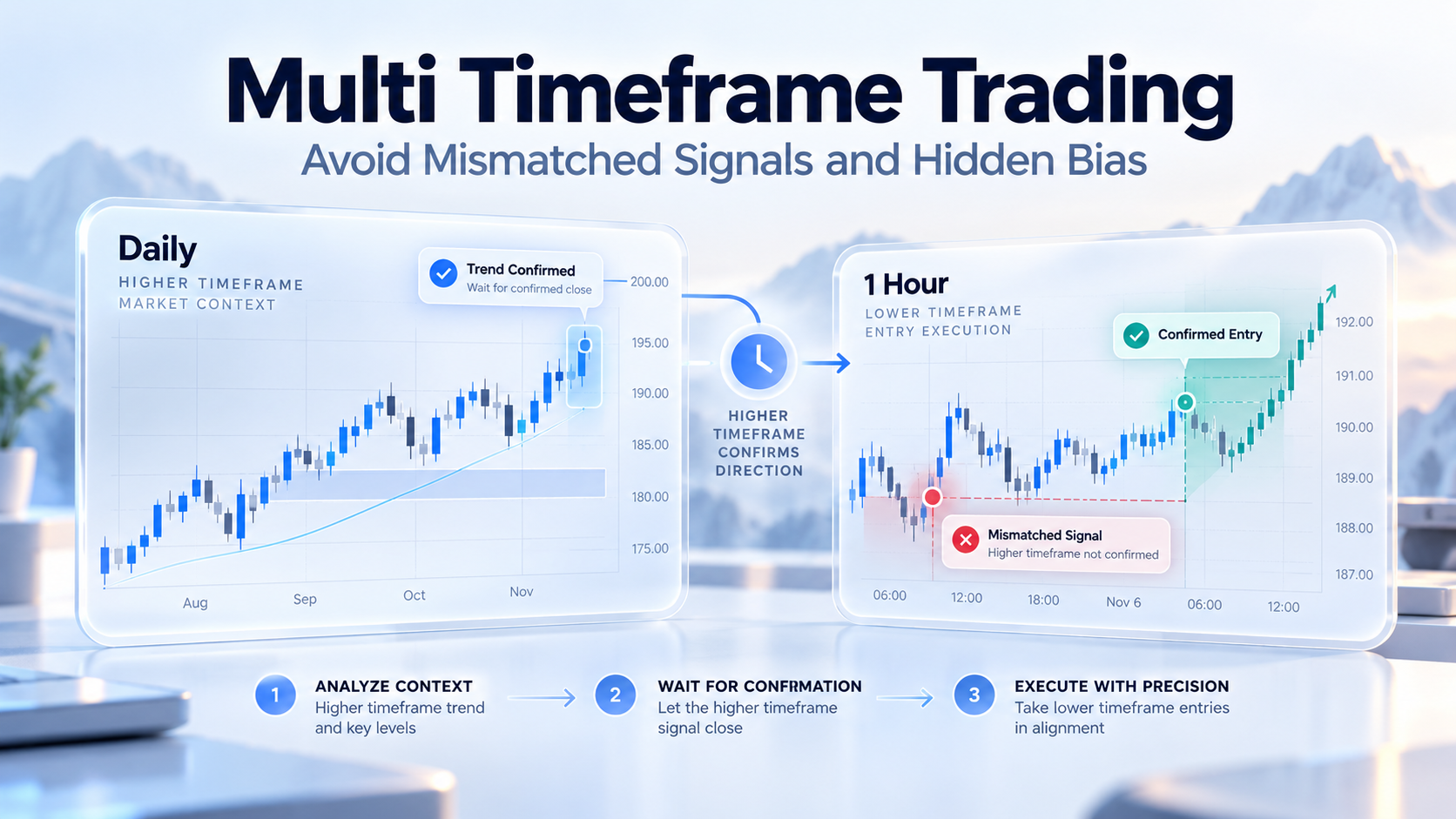
Many strategies use more than one timeframe. A trader might use the daily chart to decide whether the market is broadly bullish, then use an hourly chart for entries. The idea is sensible: use a slower view for context and a faster view for timing.
The difficulty is that multi-timeframe rules can quietly use information that was not available at the moment of a historical trade. That turns a reasonable idea into a misleading backtest.
The Core Timing Question
If a daily candle has not closed yet, its final moving average value, high, low, and close are not known. A one-hour entry at 11:00 cannot honestly use the completed daily close from 15:30.
This is the most important rule for multi-timeframe backtesting: every input must be available at the time the strategy claims to act.
Common Multi-Timeframe Mistakes
The first mistake is using the final value of a higher-timeframe bar before that bar has completed. The second is mixing timestamps carelessly, so an hourly signal is matched with a daily condition from the future. The third is failing to define whether a higher-timeframe indicator updates during the day or only after the bar closes.
Another mistake is assuming that a lower-timeframe entry can always be filled at the displayed price. Signal availability, order timing, and slippage still matter.
A Clear Rule Format
Write the sequence plainly. For example: “After the prior daily bar has closed above its 200-day moving average, allow long entries on the hourly chart. Enter only after an hourly bar closes above the breakout level.”
This tells you which information is confirmed and when. It also makes the strategy easier to reproduce.
How to Test It Honestly
Keep the higher-timeframe condition fixed until the next confirmed higher-timeframe update. Then test the lower-timeframe entry using realistic fills and costs. Compare the result with a simpler single-timeframe version; complexity should earn its place by improving clarity or robustness, not merely by producing a better historical chart.
Use the FlyTradr Strategy Builder to make the conditions explicit and review the outcome in the Backtesting Lab. If the timing cannot be explained in one or two sentences, the test needs more definition.
The Bottom Line
A higher-timeframe bar cannot provide its final value before it closes.
State exactly when each signal becomes available.
Separate confirmed context from lower-timeframe execution.
Keep fills and costs realistic on every timeframe.
Multi-timeframe logic can add useful structure. It should never add hidden hindsight.
Comments
Ask a question or leave feedback. Guests can post too.
Max 2000 characters.
No comments yet.
Quick answers
What is this article about?
Using a higher timeframe for direction and a lower timeframe for entries can be useful, but only when timing is explicit.
Who should read this article on Multi-Timeframe Trading Strategies: How to Avoid Mismatched Signals and Hidden Bias?
This article is for retail traders who want a practical understanding of multi-timeframe trading strategies: how to avoid mismatched signals and hidden bias before moving into backtesting, simulation, paper trading, or broker-connected execution.
What should I do after reading this article?
Use the article to clarify the concept first, then review FlyTradr workflow pages such as the algo trading platform overview, methodology and assumptions, or the FAQs page before making a platform decision.