


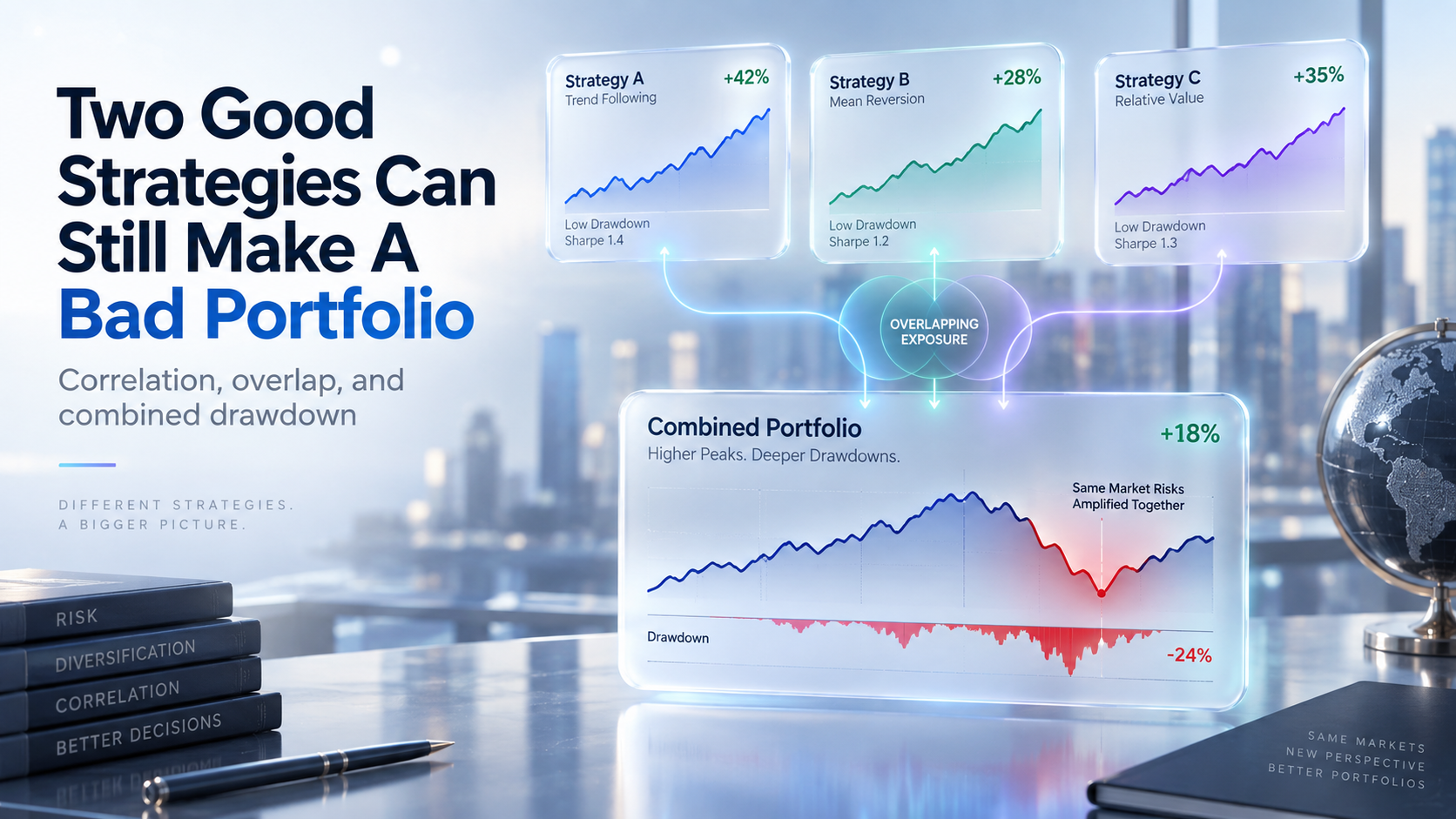
Two Good Strategies Can Still Make A Bad Portfolio
It is easy to feel diversified when you have more than one strategy.
One strategy trades breakouts. Another trades moving average crossovers. A third trades pullbacks. Each has its own backtest, its own return chart, and its own set of performance numbers. On paper, the portfolio may look broader simply because there are multiple systems running at the same time.
But more strategies do not automatically mean less risk.
If all three strategies tend to buy similar instruments, trade in the same direction, and struggle during the same market environment, they may not be as independent as they appear. What looks like three separate ideas may actually be one large exposure expressed through different rules.
That is why portfolio backtesting matters. A single strategy backtest asks how one set of rules performed in isolation. A portfolio review asks a different question, what happens when multiple strategies run together, share capital, overlap in exposure, and face weak periods at the same time.
The difference is important because traders often add strategies to reduce risk, but without reviewing correlation and combined drawdown, they may accidentally increase it.
Individual Results Are Not The Whole Story
A strategy can be profitable on its own and still make the overall portfolio more fragile.
The issue is not only whether each strategy had a positive historical result. The issue is how those strategies behave together.
Consider two trend following strategies that trade the same equity universe. One uses a moving average crossover. The other uses a breakout rule. The entry logic is different, and each strategy may have its own attractive backtest. But both may become long during strong upward markets and both may struggle when the market reverses sharply.
If those weak periods overlap, the portfolio does not experience two separate small problems. It experiences one larger combined problem.
Looking at each equity curve separately can hide this. Each strategy may appear tolerable in isolation, but when both are active at the same time, the shared risk becomes more visible.
That is why a portfolio should not be judged only by the strength of its individual parts.
What Correlation Means For Traders
Correlation is a way to describe whether two return streams tend to move together.
A high positive correlation means two strategies often rise and fall at similar times. A lower or negative correlation may suggest more independent behaviour, although it should never be treated as a guarantee of protection.
For traders, the practical meaning is simple. If two strategies usually make and lose money during the same periods, they may not provide much diversification. If one strategy tends to hold up when another is struggling, the combination may produce a smoother portfolio.
You do not need to begin with advanced statistics to make this useful.
Start by placing strategy returns on the same timeline. Look at the weeks, months, or sessions where losses occurred. Check whether weak periods were isolated to one strategy or shared across several. Review whether the strategies traded the same symbols, the same direction, the same sector, or the same market regime.
If several strategies all become long after a broad rally, the combined risk may be much larger than the standalone results suggest.
Combined Drawdown Is The Number That Matters
Every strategy has its own drawdown profile.
A strategy drawdown shows the decline from a previous equity peak during that strategy's test. This is useful, but it is not enough when multiple strategies are traded together.
A portfolio has its own drawdown too.
The combined drawdown is not simply the average of the individual drawdowns. If two strategies lose at different times, the portfolio may become smoother. If they lose together, the portfolio can fall further and faster than expected.
This is the risk that many traders miss.
A strategy with a manageable standalone drawdown can become uncomfortable when combined with another strategy that struggles during the same conditions. The individual numbers may look acceptable, but the shared weak period can create a larger portfolio level decline.
This is why adding strategies should not be judged by total return alone. Review the combined equity curve, combined drawdown, peak exposure, and the periods where several strategies were losing together.
Overlap Can Hide In Plain Sight
Strategies do not need identical rules to create overlapping risk.
They may use different indicators but trade the same index constituents. They may trade different symbols that move together during risk off periods. They may use separate entries but still depend on sustained momentum. They may trade different timeframes while building exposure in the same direction.
This is why strategy names can be misleading.
A breakout strategy and a pullback strategy may sound different, but if both are long the same market during broad risk appetite, they can still be exposed to the same reversal. A daily strategy and an intraday strategy may appear separate, but both can still depend on the same volatility environment or market trend.
Before combining strategies, write down the common dependencies.
Which markets do they trade. Which symbols or sectors do they touch. Are they usually long, short, or both. Do they depend on trends, ranges, volatility expansion, or calm conditions. How long do they hold positions. Do they increase exposure during the same market conditions.
This simple review often reveals that a portfolio is less diversified than it looks.
Capital Allocation Changes The Risk
Correlation is not the only issue. Allocation matters too.
A strategy with strong standalone returns may receive a larger allocation, but that can concentrate portfolio risk if the strategy is also highly correlated with the rest of the portfolio. A lower returning strategy may still be valuable if it behaves differently during weak periods.
This is why allocation should not be based only on historical return.
A better allocation review considers return, drawdown, correlation, trade overlap, market exposure, and how much each strategy contributes to portfolio risk. Sometimes the best portfolio addition is not the strategy with the highest backtest return. It is the strategy that adds a genuinely different source of behaviour.
The goal is not to collect the best looking backtests. The goal is to build a portfolio that can survive the periods when several ideas are under pressure.
A Simple Portfolio Review Process
A practical portfolio review starts with discipline.
First, keep each strategy version fixed while comparing combinations. If you keep changing the rules while reviewing the portfolio, it becomes difficult to know whether the improvement came from genuine diversification or from another round of tuning.
Second, align the results to the same dates. Portfolio review is only meaningful when the strategies are compared on a shared timeline. Use consistent assumptions for capital, fees, slippage, and position sizing so the comparison is not distorted.
Third, review combined returns and combined drawdown before deciding on allocations. The question is not only which strategy made the most money. The question is what happened when the strategies were active together.
Fourth, inspect uncomfortable periods. What happened when volatility increased. Did all strategies become inactive. Did they all lose at the same time. Did exposure concentrate in one direction. Did one strategy protect the portfolio, or did it simply add more of the same risk.
Finally, avoid allocating capital only because one strategy had the best historical return. That can create a portfolio built around the most overfitted result.
What To Check Before Combining Strategies
Before adding another strategy to a portfolio, ask whether it truly adds something different.
Does it trade a different market, or only the same market with a different indicator. Does it perform well during periods when existing strategies struggle. Does it reduce combined drawdown, or only increase total return during favourable periods. Does it rely on the same volatility environment, the same direction, or the same type of price behaviour.
Also review exposure.
If three strategies can all be long the same instrument at the same time, the account may be taking more risk than intended. Even if each strategy uses reasonable sizing on its own, the combined exposure can become too large when all signals align.
This is especially important for automated trading. A trader may not notice overlapping exposure quickly enough if several strategies are placing trades independently.
Portfolio review should therefore include shared exposure, not only shared performance.
How FlyTradr Fits The Workflow
FlyTradr helps traders build and review strategies as clear, separate rule sets before deciding how much capital each strategy should receive.
The Strategy Builder helps define the logic clearly. The Backtesting Lab helps review each strategy's historical behaviour, trade distribution, drawdown, and performance profile.
This matters because each strategy should be understood on its own before it is combined with others.
Portfolio level analysis should then remain an intentional review step. Do not assume that several saved strategies are diversified simply because their names, indicators, or timeframes differ. The real question is whether they create different behaviour when traded together.
The Simulator can also help review how strategies behave during specific market conditions, while the Paper Trader can help observe strategy behaviour on current market data before live exposure is considered.
If strategies eventually move toward live deployment, broker connection and live management are handled through the Dashboard. At that stage, capital allocation and overlapping exposure become even more important because the risk is no longer theoretical.
The Bottom Line
More strategies do not automatically mean less risk.
A portfolio can contain several profitable strategies and still be fragile if those strategies depend on the same market conditions, trade the same instruments, or lose money at the same time.
The useful question is not just, does each strategy have a good backtest.
The better question is, what happens when they run together.
Review returns on a shared timeline. Check overlap in symbols, direction, timeframe, and market regime. Study the combined equity curve. Judge combined drawdown, not only individual returns. Treat historical correlation as evidence, not as a permanent relationship.
Before adding another strategy, ask whether it adds a genuinely different source of behaviour, or whether it repeats a risk you already own.
That question can prevent a portfolio from becoming larger without becoming stronger.
Comments
Ask a question or leave feedback. Guests can post too.
Max 2000 characters.
No comments yet.
Quick answers
What is this article about?
Running several profitable strategies does not automatically create diversification.
Who should read this article on Two Good Strategies Can Still Make a Bad Portfolio?
This article is for retail traders who want a practical understanding of two good strategies can still make a bad portfolio before moving into backtesting, simulation, paper trading, or broker-connected execution.
What should I do after reading this article?
Use the article to clarify the concept first, then review FlyTradr workflow pages such as the algo trading platform overview, methodology and assumptions, or the FAQs page before making a platform decision.