

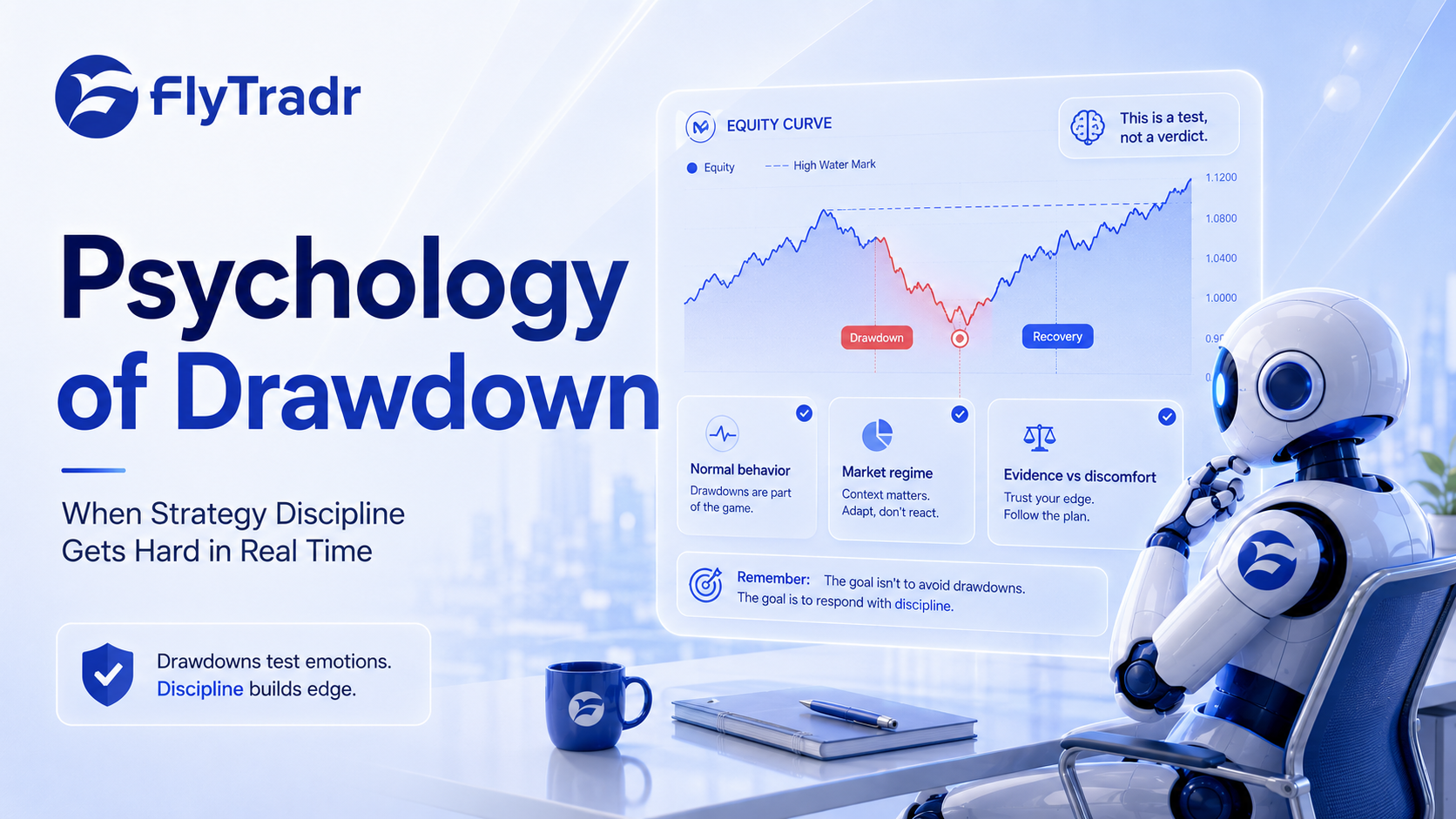
The Psychology Of Drawdown, Why Strategy Discipline Gets Hard In Real Time
Your automated strategy is in a drawdown.
It has lost 6 percent over the last 11 days. The backtest showed that this kind of decline was possible. You knew the strategy could go through weak periods. You accepted the risk when you reviewed the historical results.
Still, when it happens in real time, the feeling is different.
The chart no longer looks like a clean historical curve. It becomes your account balance. The drawdown is no longer a statistic inside a report. It starts feeling like a mistake. You begin wondering whether the strategy has stopped working, whether the market has changed, whether your rules were wrong, or whether you should switch the system off before things get worse.
This is one of the hardest parts of systematic trading. The difficult part is not always building the strategy, running the backtest, or connecting the broker. Sometimes the hardest part is sitting on your hands while a strategy you built goes through a period you already knew was possible.
That is where drawdown becomes more than a risk metric. It becomes a psychological test.
Drawdown Looks Different In A Backtest
Drawdown is usually easier to accept when it is shown inside a backtest.
You look at a historical report and see that the strategy had a maximum drawdown of 8 percent. At that moment, the number feels manageable. It is just one part of the performance summary, sitting next to return, win rate, profit factor, trade count, and the equity curve.
You may even think, I can handle that.
But a historical drawdown is compressed. You can review months of underperformance in a few seconds. You see the dip, the recovery, and the final result together. The chart gives you the comfort of knowing what happened next.
Live drawdown does not give you that comfort.
When the strategy is down 6 percent today, you do not know whether it will recover next week, continue falling, or stay flat for another month. The uncertainty changes the experience completely. A number that looked acceptable in a backtest can feel much larger when you are living through it one day at a time.
This is why drawdown discipline cannot be judged only by what you think you can tolerate while reviewing historical data. It has to be tested in forward conditions as well.
The Real Problem Is Uncertainty
Most traders do not panic during drawdowns only because of the loss itself. They panic because the drawdown creates uncertainty.
Is this normal.
Is this expected.
Is the strategy broken.
Has the market changed.
Did the backtest miss something.
Should I stop it now.
Those questions are uncomfortable because the answer is rarely obvious in real time. A strategy can underperform for perfectly normal reasons. It can also underperform because something is genuinely wrong. The difficulty is knowing which one you are dealing with.
This is why the worst question to ask during a drawdown is usually, should I switch this off.
That question is too broad, too emotional, and too easy to answer based on discomfort. A better approach is to break the review into smaller questions that can be answered with evidence.
Question 1, Is The Strategy Behaving Like It Did In The Backtest
The first question is whether the strategy is still behaving in a way that is consistent with its historical profile.
This does not mean the strategy must match the backtest exactly. It will not. Live markets are different, execution is different, and every new period has its own conditions. But the general behaviour should still make sense.
Look at the individual trades, not just the equity curve.
Is the strategy taking the kind of trades it was designed to take. Are entries appearing in the expected conditions. Are exits working according to the rules. Is trade frequency roughly in line with historical behaviour. Are losing trades within the range you expected. Is the drawdown still inside the range seen during testing.
If the answer is yes, the drawdown may be part of the system. That does not make it pleasant, but it does make it less surprising.
If the strategy is doing something it did not do in testing, that is different. Unexpected order behaviour, strange position sizing, missing exits, repeated duplicate signals, or a sudden change in trade frequency should be investigated. That is no longer just drawdown psychology. That may be an implementation, data, or execution issue.
The first job is to separate normal strategy pain from abnormal strategy behaviour.
Question 2, Has The Market Environment Changed
The second question is whether the market environment still matches the conditions the strategy was built for.
Every strategy has an environment where it tends to make more sense. A trend following strategy needs movement that continues long enough to capture. A mean reversion strategy usually prefers markets that stretch and then return. A breakout strategy often needs volatility and follow through. A range based strategy can struggle when the market begins trending strongly.
A drawdown may not mean the strategy is broken. It may mean the current market does not favour the strategy.
For example, a strategy built around trending behaviour may perform poorly in sideways chop. A strategy built around mean reversion may struggle during a strong directional move. A long only strategy may look weak when the broader market is under pressure. A short enabled strategy may behave differently when the market returns to a strong upward trend.
This is why market regime review matters.
The useful question is not just, is the strategy losing money. The better question is, is the strategy losing money in an environment where it was always expected to struggle.
If the answer is yes, the drawdown may be uncomfortable but explainable. If the strategy is losing money in the exact environment where it was expected to perform well, that deserves a deeper review.
Question 3, Am I Reacting To Evidence Or Discomfort
The third question is the hardest one.
Am I considering switching this strategy off because the evidence says something is wrong, or because the drawdown feels uncomfortable.
These are very different reasons.
Evidence may include behaviour outside the tested range, broken execution, unexpected trade frequency, a market regime that no longer matches the strategy design, or losses that exceed the risk assumptions used before deployment.
Discomfort is different. Discomfort is the feeling of watching losses unfold in real time. It is the urge to interfere because doing something feels safer than doing nothing.
The problem is that discomfort often appears before the evidence is clear.
That does not mean discomfort should be ignored. It is useful information about your risk tolerance. If a normal drawdown feels unbearable, the strategy may be too aggressive for you, even if it is functioning correctly. But that is a position sizing or deployment decision, not necessarily a strategy failure.
A trader should not let discomfort pretend to be analysis.
Why Switching Off Too Early Can Be A Problem
Pausing a strategy is sometimes the right decision. If the system is behaving unexpectedly, if execution is broken, if the market has moved outside the intended conditions, or if losses exceed predefined limits, stopping the strategy can be responsible.
But switching off simply because the strategy is in a normal drawdown can create another problem.
You may stop the system during the exact period it needs to survive in order to recover. If you later restart it after conditions improve, you may end up capturing losses and missing recovery. Over time, this can turn a historically workable system into a poor live experience because the trader keeps interrupting it at the worst moments.
This is one reason discretionary interference can damage systematic strategies. The strategy may have rules, but the trader still controls whether those rules are allowed to play out.
The answer is not blind faith. The answer is predefined decision rules.
Predefine Your Drawdown Review Before The Drawdown Happens
The best time to decide how you will handle drawdown is before the strategy is live.
Once the strategy is already losing money, it becomes much harder to think clearly. Every new loss feels like fresh evidence, even when it may still be within the expected range.
A better approach is to define a drawdown review plan in advance.
For example, before deployment, decide what drawdown level triggers a review, what drawdown level forces a pause, what metrics you will check, and what evidence would justify changing or stopping the strategy.
The review plan should include both performance and behaviour.
Performance questions might include current drawdown, maximum historical drawdown, average drawdown duration, losing streak length, and recent trade distribution.
Behaviour questions might include signal quality, trade frequency, execution accuracy, order handling, position sizing, and whether the current market regime matches the original strategy logic.
This creates structure. Instead of reacting to every weak day, you already know what to check and when to check it.
A Practical Drawdown Review Checklist
When a live or paper strategy enters a drawdown, review it in layers.
Start with the current loss. Is the drawdown still within the historical range. How does its duration compare with past drawdowns. Is the current losing streak unusual, or has the strategy experienced similar streaks before.
Then review the trades. Are the entries consistent with the strategy design. Are exits being handled correctly. Are position sizes correct. Are orders being filled as expected. Are costs or slippage materially worse than assumed.
Next, review the market environment. Is the strategy operating in the type of market it was designed for. Has volatility changed. Has trend behaviour changed. Has liquidity changed. Is the strategy being asked to perform in conditions where it was always likely to struggle.
Finally, review your own reaction. Are you following the plan you defined before deployment, or are you making a new rule because the current drawdown feels bad.
This kind of review does not remove uncertainty, but it keeps the decision grounded.
How FlyTradr Fits This Workflow
FlyTradr is built to help traders move from idea to validation with more structure.
The Backtesting Lab helps traders study historical drawdowns, losing streaks, trade distribution, and risk behaviour before a strategy is deployed. That matters because a trader should know what normal pain looked like historically before deciding whether current pain is unusual.
The Simulator can help users replay difficult periods and see how the strategy behaved during specific market environments. This is useful because drawdowns are easier to understand when you can review the trades behind the equity curve.
The Paper Trader lets traders observe a strategy on current market data without committing real capital. This helps test not only the strategy logic, but also the trader's ability to monitor underperformance without reacting too quickly.
If a strategy eventually moves toward live deployment, broker connection and live management happen through the Dashboard. At that stage, predefined review rules become even more important because the decisions are no longer theoretical.
The platform can provide structure and visibility. The trader still needs a process for deciding what to do when the strategy becomes uncomfortable.
The Bottom Line
Drawdown is not just a number in a backtest report. It is the part of systematic trading that tests whether you can follow the process you created.
A strategy can be within its expected drawdown range and still feel wrong in real time. That is normal. The problem begins when discomfort becomes the reason for changing rules, stopping systems, or abandoning a strategy without evidence.
The right response to drawdown is not blind patience. It is structured review.
Is the strategy behaving consistently with the backtest. Has the market environment changed. Are you reacting to evidence or discomfort. Those three questions will not make drawdowns pleasant, but they can make your decisions more disciplined.
The hardest part of algo trading is not always finding a strategy. Sometimes it is trusting the strategy long enough to know whether the underperformance is noise or signal.
Comments
Ask a question or leave feedback. Guests can post too.
Max 2000 characters.
No comments yet.
Quick answers
What is this article about?
Drawdown is easy to accept on a backtest chart and much harder to sit through in real time.
Who should read this article on The Psychology Of Drawdown, Why Strategy Discipline Gets Hard In Real Time?
This article is for retail traders who want a practical understanding of the psychology of drawdown, why strategy discipline gets hard in real time before moving into backtesting, simulation, paper trading, or broker-connected execution.
What should I do after reading this article?
Use the article to clarify the concept first, then review FlyTradr workflow pages such as the algo trading platform overview, methodology and assumptions, or the FAQs page before making a platform decision.