

A trading simulator is a tool for inspecting how a strategy behaves in more realistic or replay-style market conditions than a static backtest alone. It helps traders understand behavior, not just outcomes.
A simulator is useful when a backtest report is not enough. It lets you examine how a strategy actually behaved during different market periods instead of only reviewing summary metrics at the end.
That makes simulation a valuable middle stage between historical backtesting and forward paper trading. It adds context to the numbers.
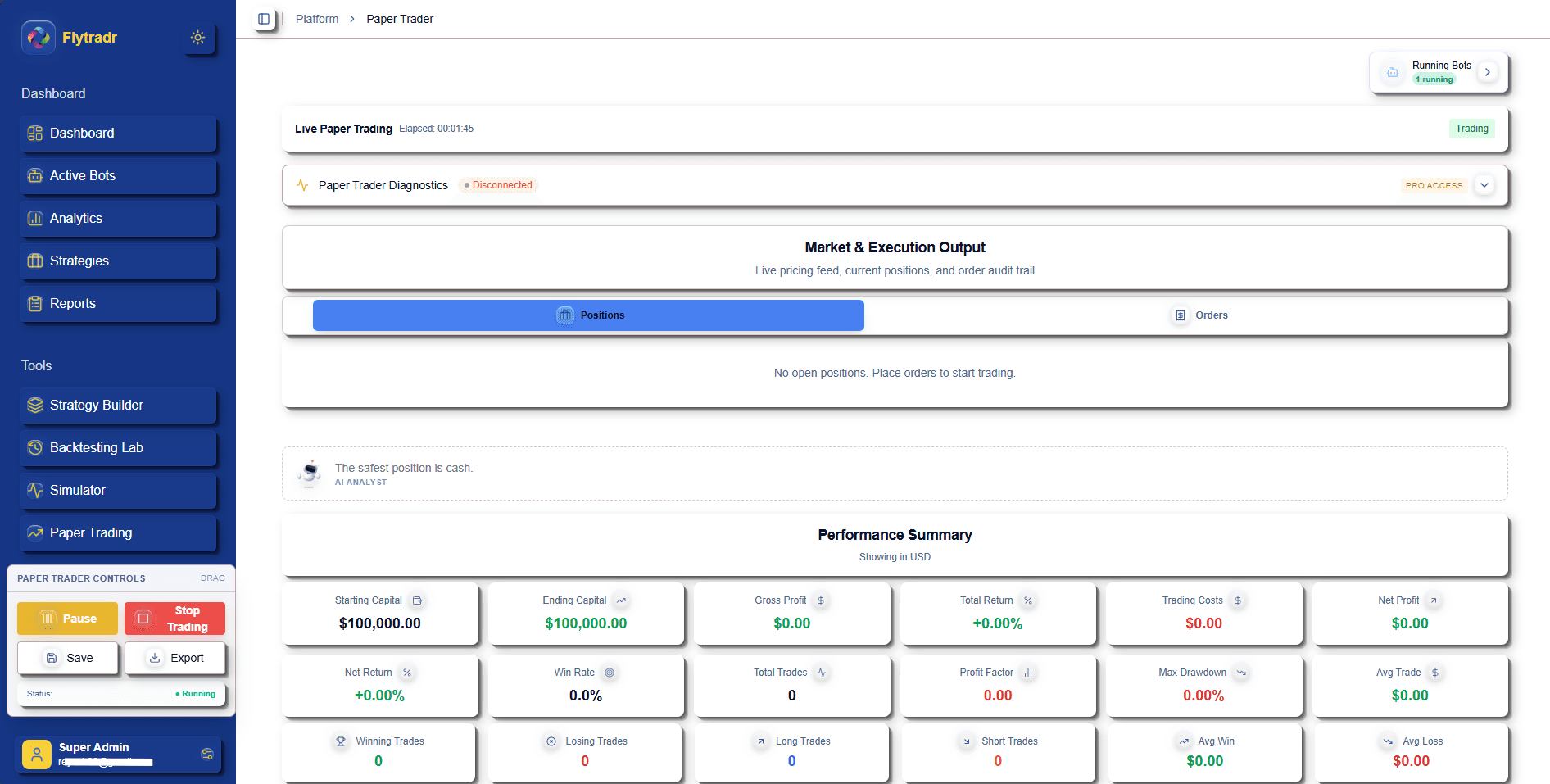
A trading simulator helps traders inspect behavior between the backtest report and the paper-trading stage.
What a trading simulator helps you see
- Behavior in context: how the strategy reacts during trend, chop, and volatility.
- Execution realism: whether timing, assumptions, and transitions make practical sense.
- Workflow confidence: whether the strategy remains understandable when you inspect the path, not just the summary.
How it differs from other validation stages
- Backtesting tells you what the historical result looked like.
- Simulation helps you inspect how that result unfolded in more detail.
- Paper trading helps you test execution discipline in a forward virtual-capital workflow.
Where a simulator fits in the workflow
A practical retail workflow usually moves from the broader platform workflow into backtesting, then simulation, and then paper trading. Simulation is the stage that helps you inspect the path between the historical report and the forward-testing stage.
Who should use a trading simulator
Best for
- Retail traders who want to inspect how a strategy behaves during difficult market periods.
- Users who need a bridge between backtesting reports and paper trading discipline.
- Traders who want to review timing, market behavior, and strategy reactions more closely.
Not ideal for
- Anyone who wants to skip historical validation and jump straight into simulation.
- Users who expect a simulator alone to prove real-world performance.
- Traders who only want a final score and do not care how the strategy actually behaved.