

Paper trading means testing a strategy with virtual capital in forward market conditions. It helps traders practice execution and validate workflow behavior without risking real money.
Paper trading sits between strategy validation and real capital. It gives you a chance to see how a system behaves in practice before the psychological and financial pressure of live execution enters the picture.
That makes it useful, but not magical. A paper-trading result is more realistic than a backtest in some ways, yet it is still not the same as real-money trading.
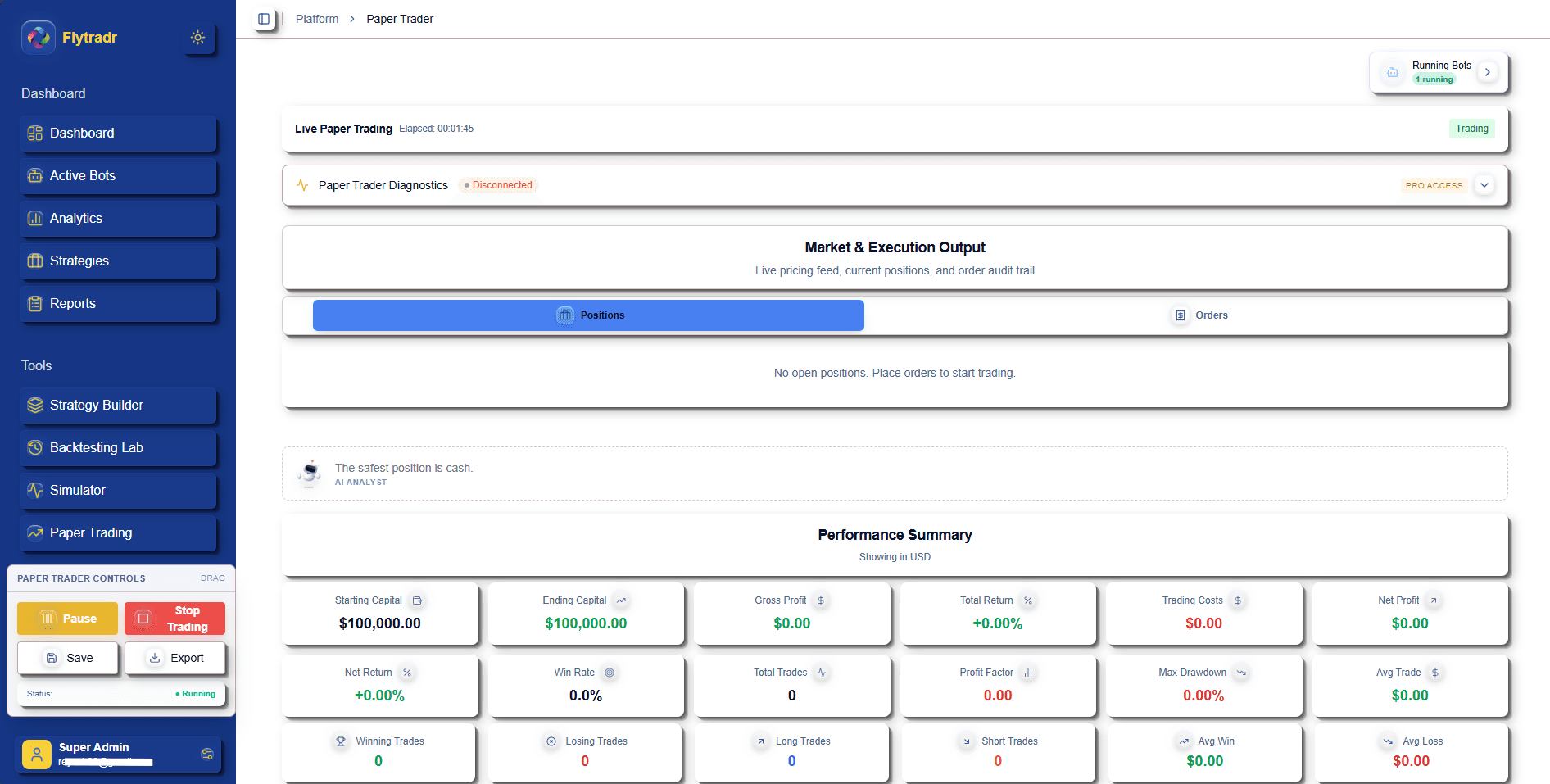
Paper trading is most useful when it is treated as a deliberate validation stage, not as proof by itself.
What paper trading validates
- Execution discipline: whether entries, exits, and position sizing are followed as intended.
- Workflow behavior: whether the strategy remains understandable outside the backtest report.
- Operational readiness: whether the process is stable enough to continue into deeper evaluation.
What paper trading does not prove
- It does not fully reproduce the emotional pressure of real-money trading.
- It does not guarantee identical fills, liquidity, or market conditions.
- It does not replace a proper backtesting and simulation process.
Where paper trading fits in the workflow
A practical retail workflow usually starts with the broader platform workflow, then backtesting, then simulation, and then paper trading. That sequence reduces risk by making the strategy earn trust step by step instead of all at once.
Who should use paper trading
Best for
- Retail traders who want to practice execution without risking capital.
- Users who need a forward-testing step after backtesting and simulation.
- Traders who want to check whether a strategy remains understandable and disciplined in practice.
Not ideal for
- Anyone who wants to skip historical validation and jump straight into forward testing.
- Users who treat virtual results as proof of live-market profitability.
- Traders who want certainty rather than staged risk reduction.
Related pages
Algo trading platform
See the full FlyTradr workflow.
Paper trading
FlyTradr product page for paper trading.
What is backtesting in trading
Historical validation explainer.
What is a trading simulator
Simulation explainer.
Trading simulator
FlyTradr simulation workflow.
Learn hub
Browse more educational pages.