

How To Avoid Overfitting Your Backtest, The Curve Fitting Problem Explained
One of the easiest ways to fool yourself in strategy testing is to keep improving a backtest until it looks excellent.
At first, it feels like normal refinement. You change a moving average length. You adjust a filter. You test a different exit. You remove one poor performing period. You try another timeframe. Each change makes the result look a little better, and eventually the strategy produces the kind of chart every trader wants to see.
The problem is that the strategy may not have become stronger. It may simply have become better fitted to the historical data used during testing.
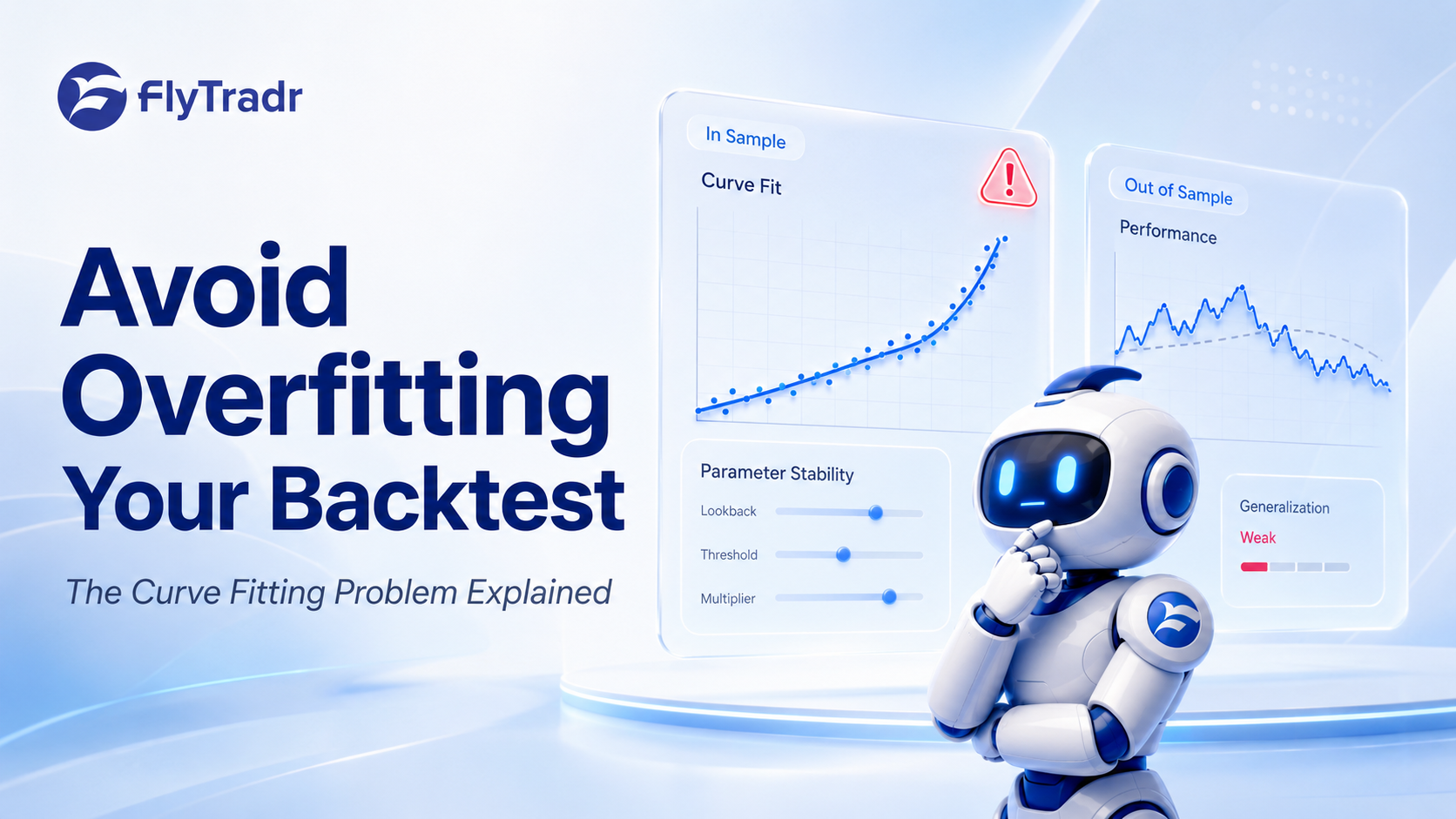
This is overfitting, also called curve fitting. It happens when a strategy is tuned so closely to past data that it starts learning noise instead of a repeatable market behaviour. The backtest improves, but the strategy becomes less likely to hold up when tested on new data or traded forward.
For algo traders, this is one of the most important problems to understand. A bad backtest is easy to reject. A beautiful but overfitted backtest is much more dangerous because it creates confidence in a strategy that may never have had a real edge.
What Overfitting Actually Means
Overfitting happens when a strategy becomes too closely matched to the specific historical data used to build it.
A trading strategy should ideally capture a broad behaviour that has some chance of repeating. For example, it may be based on momentum, mean reversion, volatility expansion, trend continuation, or another market behaviour that can be explained and tested. An overfitted strategy does something different. It adapts itself to the exact accidents of the past.
Consider a simple moving average crossover idea. You test it with one set of values and the result is acceptable. Then you adjust the values and the result improves. You keep testing more combinations until one particular pair gives a much stronger return with a cleaner drawdown.
That result may look like discovery, but it may simply be selection. Out of all the combinations tested, one was likely to fit that specific period best. The question is whether it fits because it captures a real behaviour, or because it happened to match the noise in that historical sample.
This is the central problem with overfitting. The strategy looks smart because it has already seen the answers.
Why Overfitting Happens So Easily
Overfitting does not always happen because someone is trying to manipulate the result. More often, it happens through ordinary experimentation.
Every time you run a backtest, look at the result, change something, and run it again, you are learning from the same historical data. That is not automatically wrong. Strategy development requires testing and refinement. The problem starts when the same data is used both to build the strategy and to judge whether the strategy is reliable.
The more changes you try, the easier it becomes to find something that looks good by chance. A strategy with several adjustable parameters can produce hundreds of possible combinations. If all of them are tested on the same dataset, at least one version may look impressive even if the underlying idea is weak.
This is sometimes called data mining bias or selection bias. The final backtest looks strong because it is the best result selected from many attempts, not because it necessarily represents a durable edge.
That distinction matters. A strategy chosen after many attempts should be treated differently from a strategy that was defined in advance and then tested honestly on fresh data.
A Simple Way To Think About Curve Fitting
Imagine drawing a line through a set of points.
A simple line may not touch every point, but it captures the general direction. A very complicated curve may pass through every point perfectly. It looks more accurate on that dataset, but it may perform worse when new points are added.
Trading strategies can behave the same way. A simple strategy may not catch every move, avoid every drawdown, or optimise every exit. But if the underlying idea is reasonable, it may continue to behave sensibly across different periods.
An overfitted strategy tries too hard to explain the past. It may avoid historical losses, capture historical reversals, and optimise historical entries in a way that looks impressive. But when the future arrives, the exact pattern it was tuned to may not repeat.
The goal is not to build a strategy that explains every historical move. The goal is to build a strategy that remains useful when the next set of data is different from the last one.
Warning Signs Of An Overfitted Backtest
Overfitting can be difficult to prove from a summary page alone, but there are warning signs.
A strategy that performs well only with one exact parameter combination deserves scrutiny. If a setting works at one value but fails badly when the value is moved slightly higher or lower, the strategy may be too sensitive. A robust idea usually has a reasonable range where behaviour remains broadly similar.
A very smooth equity curve can also be suspicious. Real strategies usually have weak periods, losing streaks, and uncomfortable drawdowns. A backtest that climbs almost perfectly without meaningful setbacks may be using rules that were tuned to avoid the specific problems in that historical period.
Another warning sign is a large gap between in sample and out of sample performance. If the strategy performs extremely well on the data used during development but weakly on fresh data, it may have learned the development period too closely.
You should also be cautious when a strategy has many conditions that each seem to remove a small problem. One filter removes bad trades in one year. Another avoids a drawdown in another period. Another improves one market regime. Individually, each change may seem reasonable. Together, they may create a strategy that is shaped around historical exceptions rather than a real trading idea.
The Role Of Parameters
Parameters are not bad. Every strategy has choices. A moving average strategy needs lookback periods. A breakout strategy needs a range definition. A volatility based strategy needs a volatility window. A risk model needs sizing rules.
The issue is not that parameters exist. The issue is how they are chosen.
If parameter values are selected only because they produced the highest return on one historical dataset, the strategy is vulnerable to overfitting. If nearby values perform reasonably well, the result becomes more credible. This is sometimes called parameter stability.
For example, assume one version of a strategy performs well with a lookback value of 20. If values around 18, 19, 21, and 22 also produce acceptable results, the idea may be less fragile. If only 20 works and every nearby value collapses, the result should be questioned.
A strong strategy should not require perfect historical tuning to remain functional.
In Sample And Out Of Sample Testing
One of the most important defences against overfitting is separating the data used for development from the data used for evaluation.
The development period is usually called in sample data. This is where you explore the idea, test variations, and make reasonable choices.
The evaluation period is called out of sample data. This is data the strategy has not used during development. It is meant to provide a cleaner test of whether the idea generalises beyond the period it was tuned on.
A simple workflow may look like this. Use the first part of the historical data to develop the strategy, then test the final rules on a later period that was not used while building it. If the out of sample result is broadly consistent with the in sample behaviour, the strategy becomes more credible. If performance collapses, the original backtest may have been overfitted.
The important part is discipline. Once you review the out of sample result, it is tempting to go back and make changes. If you do that repeatedly, the out of sample data is no longer clean. It becomes part of the development process.
Walk Forward Testing
Walk forward testing is a more structured way to test whether a strategy can adapt across time.
Instead of using one fixed training period and one fixed test period, walk forward testing uses a series of rolling windows. The strategy is developed or calibrated on one period, then tested on the next period. The window then moves forward and the process repeats.
This can be useful because markets change. A strategy that only works in one historical block may struggle when the market regime shifts. Walk forward testing helps show whether the idea can continue producing reasonable results across multiple unseen periods.
It is not a perfect solution. Poorly designed walk forward testing can still overfit if the process is too flexible or if too many versions are compared. But it is usually more informative than relying on one carefully selected historical period.
The goal is not to find the single best historical configuration. The goal is to see whether the strategy logic remains sensible as time moves forward.
Test Across Market Regimes
A strategy should not be judged only by its total return over the full backtest.
A full period result can hide where the money was actually made. The strategy may have earned most of its gains during one strong trend, one volatility event, or one favourable market regime. If so, the average result may look better than the strategy really is.
This is why it helps to review performance across different market environments. How did the strategy behave during trending periods. How did it behave during sideways markets. What happened during high volatility. What happened during drawdowns. Did one year drive most of the return.
The aim is not necessarily to build a strategy that works equally well everywhere. That may not be realistic. The aim is to understand the conditions where the strategy is strong and the conditions where it struggles.
A strategy that only works in one environment can still be useful, but it should be understood that way. The danger comes from treating a regime specific backtest as if it proves a universal edge.
Keep The Strategy Logic Explainable
A strategy does not need a complicated story, but it should have a reason to exist.
If the logic is only, this combination worked best in the backtest, that is weak evidence. A stronger strategy has an idea behind it that can be explained before looking at the result.
For example, a trend following strategy may aim to participate in persistent directional moves. A mean reversion strategy may aim to capture short term overreaction. A volatility strategy may respond to expansion or contraction in price movement.
The explanation does not guarantee success. Markets can still change, and sensible ideas can still fail. But an explainable idea is less likely to be the product of random parameter searching.
This is especially important in no code strategy building. When it becomes easy to test many combinations, it also becomes easy to mistake experimentation for validation. The easier the tool makes testing, the more important it becomes to stay disciplined about why each rule exists.
Use Simpler Rules Where Possible
Complexity is not automatically bad, but every additional rule needs to earn its place.
A filter that improves one backtest may not improve the strategy. It may only remove a historical inconvenience. A second filter may remove another weak period. A third may improve one year while weakening another. Soon the strategy becomes a collection of patches built around the past.
A simpler strategy is easier to understand, easier to test, and easier to diagnose when behaviour changes. It also has fewer opportunities to fit random noise.
This does not mean every strategy should be basic. Some strategies genuinely need more conditions. The key question is whether each additional rule improves robustness across multiple tests, or whether it only improves the original backtest.
If a rule cannot be explained and does not hold up across different periods, it probably should not be there.
Paper Trading As A Forward Test
Paper trading is not a guarantee, but it is a useful next layer of validation.
A backtest reviews historical data. Paper trading observes the strategy on current market data with simulated capital. This exposes the strategy to information that was not available when the rules were built.
If a strategy looked excellent in backtesting but behaves poorly during paper trading, that does not automatically prove overfitting. The market may have changed. The paper trading sample may be too short. Execution assumptions may differ. But it is still a warning that deserves investigation.
The reverse is also useful. If a strategy performs reasonably in paper trading, even if not as cleanly as the backtest, that gives more confidence that the idea is not purely a historical fit.
Paper trading should not be treated as proof. It should be treated as another filter before real capital is involved.
A Practical Overfitting Checklist
Before trusting a backtest, ask a few uncomfortable questions.
Did I choose this strategy because the logic made sense, or because it was the best result after many attempts.
Did I tune the parameters and evaluate performance on the same data.
Does the strategy still behave reasonably when parameters are changed slightly.
Does performance hold across different time periods, or does one period explain most of the return.
Have I tested the strategy on out of sample data.
Have I reviewed performance across different market regimes.
Did each additional rule improve robustness, or only improve the original backtest.
Does the average trade leave enough room for costs and slippage.
Have I observed the strategy through paper trading before considering live deployment.
These questions will not eliminate risk. They will reduce the chance of trusting a strategy that only worked because it was shaped too closely around the past.
How FlyTradr Fits This Workflow
FlyTradr is designed to help traders move from idea to validation without needing to code every test manually.
The Strategy Builder helps turn a trading idea into clear rules. The Backtesting Lab helps test those rules on historical data and compare performance across different variations. The Simulator can help review behaviour across selected market periods, while the Paper Trader lets users observe the strategy on current market data before live deployment.
If a strategy eventually moves toward live trading, broker connection and deployment are managed through the Dashboard.
The workflow matters because the goal is not to find the most impressive backtest. The goal is to build enough evidence to decide whether the idea deserves more attention.
A good validation process should make it harder to fool yourself. It should help you compare variations, check sensitivity, review drawdowns, model costs, and test the strategy forward before real capital is involved.
The Bottom Line
Overfitting is dangerous because it can make a weak strategy look strong.
The strategy may not be capturing a real market behaviour. It may only be describing what would have worked best in the past. When the next period arrives, that carefully fitted pattern may disappear.
The defence is not to stop backtesting. Backtesting is still one of the most useful tools a trader has. The defence is to use it more carefully.
Keep the logic explainable. Avoid unnecessary complexity. Separate development data from evaluation data. Test across market regimes. Check parameter stability. Use paper trading as a forward test. Treat the best historical result as a candidate, not as proof.
A backtest should help you understand a strategy, not convince you too quickly.
Comments
Ask a question or leave feedback. Guests can post too.
Max 2000 characters.
Nior
·2026-07-28
Thank you so much for taking the time and effort to write this article. I can only imagine how much research, experience, and thought went into putting all of this together. It's not often that you find content that teaches not just what to do, but 'how to think'. What I appreciate most is that you didn't just explain how to avoid overfitting you encouraged readers to think like real researchers. The emphasis on forming hypotheses, questioning results, testing robustness instead of chasing perfect backtests, and treating evidence with healthy skepticism is incredibly valuable. Those lessons are far more important than any single trading strategy. As someone who is learning quantitative research and strategy development, this article has genuinely changed the way I approach my work. It reminded me that the goal isn't to build the most beautiful backtest, but to discover something that can survive in the real world. Thank you again for generously sharing your knowledge with the community. Resources like this help raise the standard of trading education and inspire people like me to become better researchers, not just better backtesters. I truly appreciate the time and effort you invested in creating this.
Quick answers
What is this article about?
A strategy can look excellent in a backtest and still fail when tested on new data.
Who should read this article on How To Avoid Overfitting Your Backtest, The Curve Fitting Problem Explained?
This article is for retail traders who want a practical understanding of how to avoid overfitting your backtest, the curve fitting problem explained before moving into backtesting, simulation, paper trading, or broker-connected execution.
What should I do after reading this article?
Use the article to clarify the concept first, then review FlyTradr workflow pages such as the algo trading platform overview, methodology and assumptions, or the FAQs page before making a platform decision.