

How To Avoid Lookahead Bias In Backtests, A Practical Checklist For Algo Traders
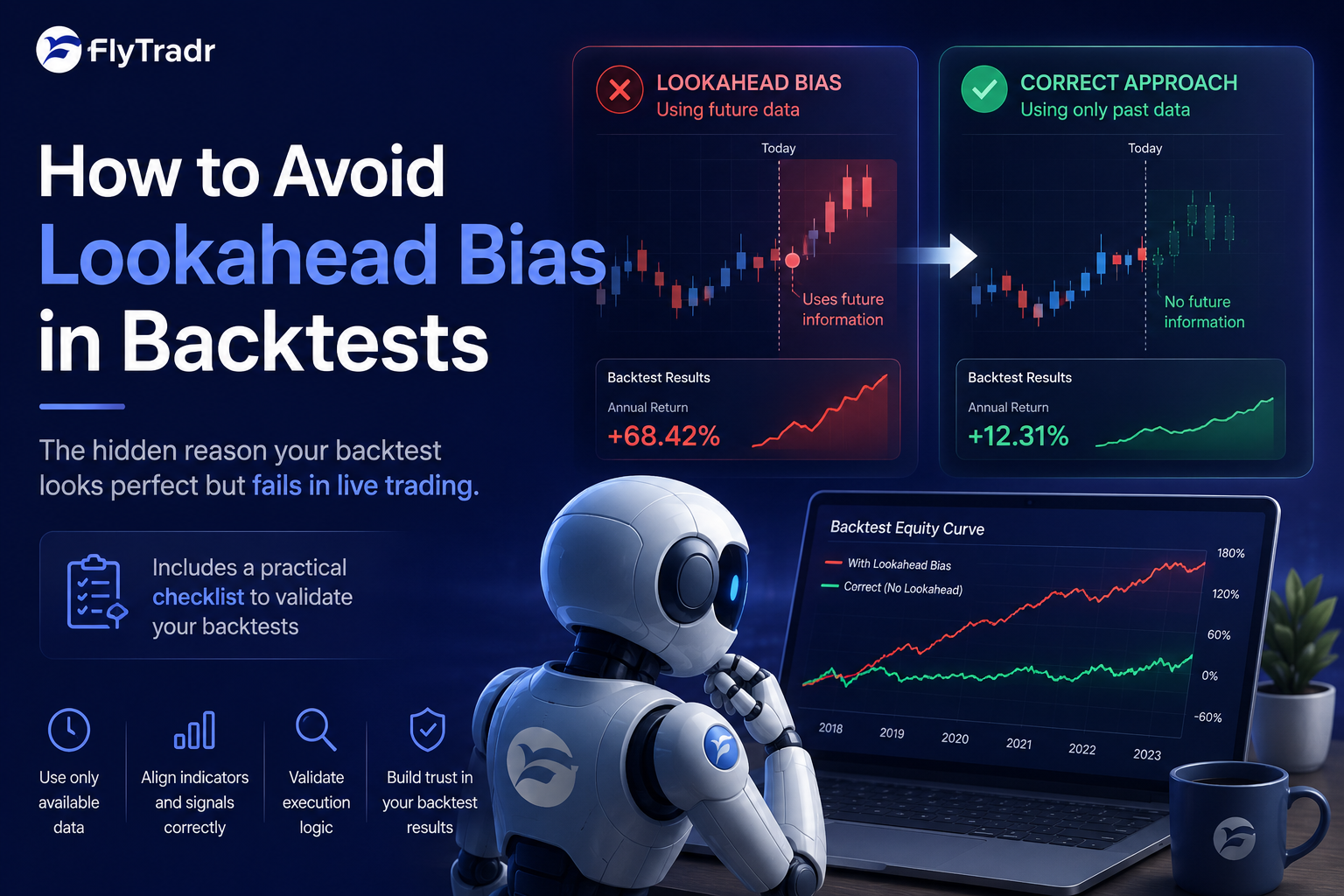
A backtest can fail for many reasons, but lookahead bias is one of the most dangerous because it can make a broken strategy look excellent.
The problem is simple. The backtest accidentally allows the strategy to use information that would not have been available at the time of the trade. The result may look clean, profitable, and surprisingly consistent. But the strategy is not really discovering an edge. It is being helped by the future.
That is why lookahead bias is so damaging. A normal bad strategy usually shows poor results and forces you to move on. A biased backtest does the opposite. It gives you confidence in something that was never tradable in the first place.
For algorithmic traders, this is especially important because small timing mistakes can quietly change the entire result. An indicator may use the current bar before that bar has closed. A signal may buy at a price that was only known later. A portfolio rule may select stocks using performance that had not yet happened.
In this guide, we will break down what lookahead bias is, where it commonly appears, how to detect it, and how to use a practical checklist before trusting a backtest.
What Lookahead Bias Means
Lookahead bias happens when a backtest uses future information to make a past decision.
Suppose a strategy is being tested on hourly bars. At 10:00, the strategy should only know what happened up to that point. It should not know the 10:00 to 11:00 candle high, low, or close until that candle has finished.
If the strategy makes a decision at 10:05 using the final high or close of the 10:00 to 11:00 candle, the test is no longer realistic. It has information from the future.
This mistake can appear harmless in code, especially when data is stored in neat columns. Historical datasets make every value look equally available, but a real strategy experiences data sequentially. It sees the market one bar, one tick, or one update at a time.
That difference between historical availability and real time availability is where lookahead bias enters.
Why Lookahead Bias Inflates Results
A strategy with lookahead bias is not playing by the same rules as a live strategy.
It may appear to enter near the low of a candle, avoid bad trades, exit before a reversal, or select the strongest instruments before they become strong. These results can look impressive, but they are often created by information leakage rather than genuine strategy logic.
This is why biased backtests can show unusually high win rates, unusually smooth equity curves, and unusually small drawdowns. The strategy is not necessarily better. It is simply seeing information that a live system would not have.
The real danger is not only that the backtest is wrong. The bigger danger is that it looks convincing enough to push the trader toward paper trading or live deployment with false confidence.
Common Ways Lookahead Bias Enters A Backtest
Lookahead bias is not always obvious. It often comes from reasonable sounding shortcuts that are easy to miss during development.
Using A Completed Candle Too Early
This is one of the most common causes.
A daily strategy may decide to buy at the same day's close based on that same day's closing price. That is only valid if the decision is made after the close and the trade is executed later. If the backtest assumes that the strategy both sees the closing price and executes at that same closing price, the timing may be unrealistic.
The same issue appears in intraday testing. If a strategy uses the high, low, or close of a candle before that candle has completed, the backtest is giving the system future knowledge.
A safer rule is to separate signal generation from execution. If the signal is confirmed at the close of one bar, the trade should usually execute on the next available bar or according to a clearly defined execution model.
Indicators That Include Future Or Current Bar Data Incorrectly
Indicators can also create lookahead bias if they are calculated with data that would not have been available at the decision point.
For example, a moving average used for a decision at the start of a candle should not include that candle's final close. The final close is not known yet. If the indicator includes it, the strategy is partly using future information.
This does not mean indicators cannot use the current bar in any context. It depends on when the strategy is supposed to act. A strategy acting after a bar closes can use that bar's final values, but then the execution must happen after that information is available.
The important question is always the same.
What did the strategy know at the exact time it made the decision.
Using Full Period Highs And Lows For Earlier Decisions
Another common mistake is using the high or low of a full period to justify an entry that supposedly happened inside that same period.
For example, a strategy may check whether price touched a support level during the day and then assume it entered earlier at a favourable price. But if the test is based only on daily data, it may not know the sequence of events inside the day.
Did the low happen before the close. Did the entry condition happen before the exit condition. Did the stop trigger before the target. Without intraday sequence data, the backtest may be making assumptions that favour the strategy.
This is one reason lower timeframe or bar by bar simulation can be important when the exact order of events matters.
Selecting Instruments Using Future Performance
Lookahead bias is not limited to entries and exits. It can also appear in portfolio selection.
Suppose a strategy rebalances monthly and selects the top performing instruments for the current month. If it uses the full month's return to decide what should have been bought at the start of that month, it is using future performance.
The correct approach is to use information that would have been available before the rebalance date. For example, a monthly rotation strategy might use the previous month's return to decide the next month's allocation.
The distinction seems small, but it completely changes the validity of the result.
Misusing Adjusted Data
Corporate actions such as splits and dividends can make historical price data difficult to handle.
Adjusted data is useful because it creates a cleaner historical series, but it can create problems if the strategy logic, order sizing, stop levels, or threshold rules are not consistent with the adjusted prices.
The issue is not that adjusted data is always wrong. The issue is that the backtest must be internally consistent. If price history is adjusted, the rules using that price history must make sense in the adjusted data environment.
For equities, this is an area worth checking carefully, especially if the strategy uses fixed price thresholds or compares historical prices across corporate action dates.
Red Flags That Suggest Lookahead Bias
Lookahead bias is easier to prevent than to diagnose after the fact, but there are warning signs.
A very high win rate is not automatically wrong, but it should make you curious. If a directional strategy shows an unusually high win rate, almost no losing streaks, and near perfect entries or exits, the test deserves closer review.
Another warning sign is a large gap between backtest and forward behaviour. If a strategy looks excellent historically but behaves completely differently in paper trading, one possibility is that the backtest used information that was not available in real time.
Suspicious trade placement is also worth checking manually. If the system repeatedly buys close to candle lows, sells close to candle highs, avoids nearly every losing setup, or appears to know reversals before they happen, do not assume the strategy is brilliant. First check the timing logic.
Good strategies still lose trades. They still experience drawdowns. They still have imperfect entries and exits. If a backtest looks too clean, it may be because the test is not realistic.
A Practical Lookahead Bias Checklist
Before trusting any backtest, it helps to walk through the logic slowly and ask what the strategy knew at each decision point.
Data Availability
Check whether every input used by the strategy was available at the time the decision was made. This includes prices, indicators, rankings, filters, portfolio values, and external data.
If the strategy uses a value from the current bar, confirm whether the decision is meant to happen after that bar closes. If it is, the execution should happen after the close, not at a price that was available earlier.
Indicator Timing
Review how every indicator is calculated.
A moving average, ATR, RSI, Bollinger Band, or any other indicator should be calculated using the correct data window for the decision time. If the strategy acts before the current bar is complete, the final current bar value should not be part of the calculation.
The indicator code should match the trading logic. A signal generated at bar close is different from a signal generated during the bar.
Signal And Execution Order
Separate the moment a signal is detected from the moment an order is executed.
A common safer pattern is:
Bar closes.
Signal is evaluated.
Order is placed for the next executable price.
This avoids the unrealistic assumption that the strategy can use a closing value and also trade at that same close unless the execution model specifically supports that assumption.
Portfolio Selection Rules
For ranking, rotation, or rebalancing strategies, verify that the selection uses past data only.
If a strategy selects the best performers of a period, make sure it is selecting based on a completed prior period, not the same period it is pretending to trade.
Corporate Actions And Adjusted Data
If the backtest uses adjusted prices, check whether the strategy rules are compatible with those adjusted prices.
This is especially important for fixed price thresholds, position sizing, stop levels, and long historical equity tests that cross split or dividend dates.
Edge Cases
Review what happens when data is missing or incomplete.
The first few bars may not have enough history to calculate indicators. Instruments may have gaps, halted trading, missing candles, or unusual corporate events. A backtest should handle these cases explicitly rather than accidentally filling the gap with future data.
Manual Trade Review
Pick a small sample of trades and inspect them manually.
For each trade, ask:
What information was available before the signal.
When was the signal generated.
When was the order placed.
What price could realistically have been filled.
Did the exit happen after the entry in a valid sequence.
Manual review often catches timing mistakes that summary metrics hide.
A Simple Delay Test
One practical way to detect possible lookahead bias is to delay the strategy by one bar and compare the results.
If the original test enters immediately after a signal, create a version that waits until the next bar. If the strategy is robust, the result may change, but it should not completely collapse unless the edge depends heavily on immediate execution.
If the delayed version performs dramatically worse, that does not automatically prove lookahead bias, but it is a strong reason to inspect the timing assumptions.
This test is especially useful for strategies that appear to capture exact turning points or react perfectly to candle level information.
Why Bar By Bar Simulation Helps
A bar by bar simulation processes historical data sequentially.
Instead of treating the full dataset as if every value is available at once, the simulator moves through time step by step. At each point, the strategy only sees the information that would have been available by then.
This does not solve every problem. A bar based backtest can still make unrealistic assumptions about fills inside the bar, especially if the strategy depends on intrabar highs and lows. But sequential processing reduces the risk of accidentally using future rows of data in the strategy logic.
For many retail traders, this is a useful practical safeguard. It makes the backtest behave more like a forward running system.
How FlyTradr Helps Reduce Lookahead Risk
FlyTradr's Backtesting Lab is designed around sequential strategy evaluation rather than treating the full dataset as a single block of information.
That matters because a strategy should not be allowed to know future candles while making current decisions. A backtest should move through the data in order, update indicators at the right time, evaluate signals, and execute orders according to the defined execution model.
This kind of workflow helps reduce common lookahead mistakes, but it does not remove the need for judgement. The trader still needs to define sensible rules, choose realistic execution assumptions, and review whether the strategy logic makes sense.
Once the historical result looks reasonable, the next step is not immediate live deployment. The strategy should be reviewed in the Simulator, then observed on current data through the Paper Trader. If it eventually moves toward live deployment, broker connection and live management happen through the Dashboard.
The platform can help structure the testing process. The responsibility is still to question the result before trusting it.
Common Mistakes To Avoid
Trusting Perfect Entries
If a strategy repeatedly buys near lows and sells near highs, check whether the backtest knew those highs and lows before a real strategy would have known them.
Using The Current Bar Without Defining Timing
Using the current bar is not automatically wrong, but the timing must be clear. If the signal uses the close of the current bar, the trade should not also assume execution earlier inside that same bar.
Ignoring Portfolio Ranking Timing
If a portfolio strategy selects instruments based on performance, make sure the selected performance data was available before the rebalance decision.
Treating Paper Trading Failure As A Surprise
If a strategy collapses immediately in paper trading, do not only blame the market. Check whether the backtest used information that was unavailable during live operation.
Only Reviewing Summary Metrics
Lookahead bias often hides behind attractive summary statistics. Review individual trades, timestamps, signal timing, and execution assumptions.
The Bottom Line
Lookahead bias is not just a technical bug. It is a trust problem.
If a backtest uses future information, the results no longer represent the strategy that would have traded in the real world. The backtest may look better, but it becomes less useful.
The goal of backtesting is not to create the most impressive historical result. The goal is to create a realistic test that helps you decide whether an idea deserves further validation.
That means checking data availability, indicator timing, signal execution order, portfolio selection rules, adjusted data handling, and edge cases.
A clean backtest will still have losing trades, imperfect entries, and periods of weakness. That is normal. A realistic backtest should look tradable, not magical.
Comments
Ask a question or leave feedback. Guests can post too.
Max 2000 characters.
No comments yet.
Quick answers
What is this article about?
Lookahead bias makes a strategy use information that would not have been available at the time of the trade.
Who should read this article on How To Avoid Lookahead Bias In Backtests, A Practical Checklist For Algo Traders?
This article is for retail traders who want a practical understanding of how to avoid lookahead bias in backtests, a practical checklist for algo traders before moving into backtesting, simulation, paper trading, or broker-connected execution.
What should I do after reading this article?
Use the article to clarify the concept first, then review FlyTradr workflow pages such as the algo trading platform overview, methodology and assumptions, or the FAQs page before making a platform decision.