

Long and Short Strategies Are Not Mirror Images
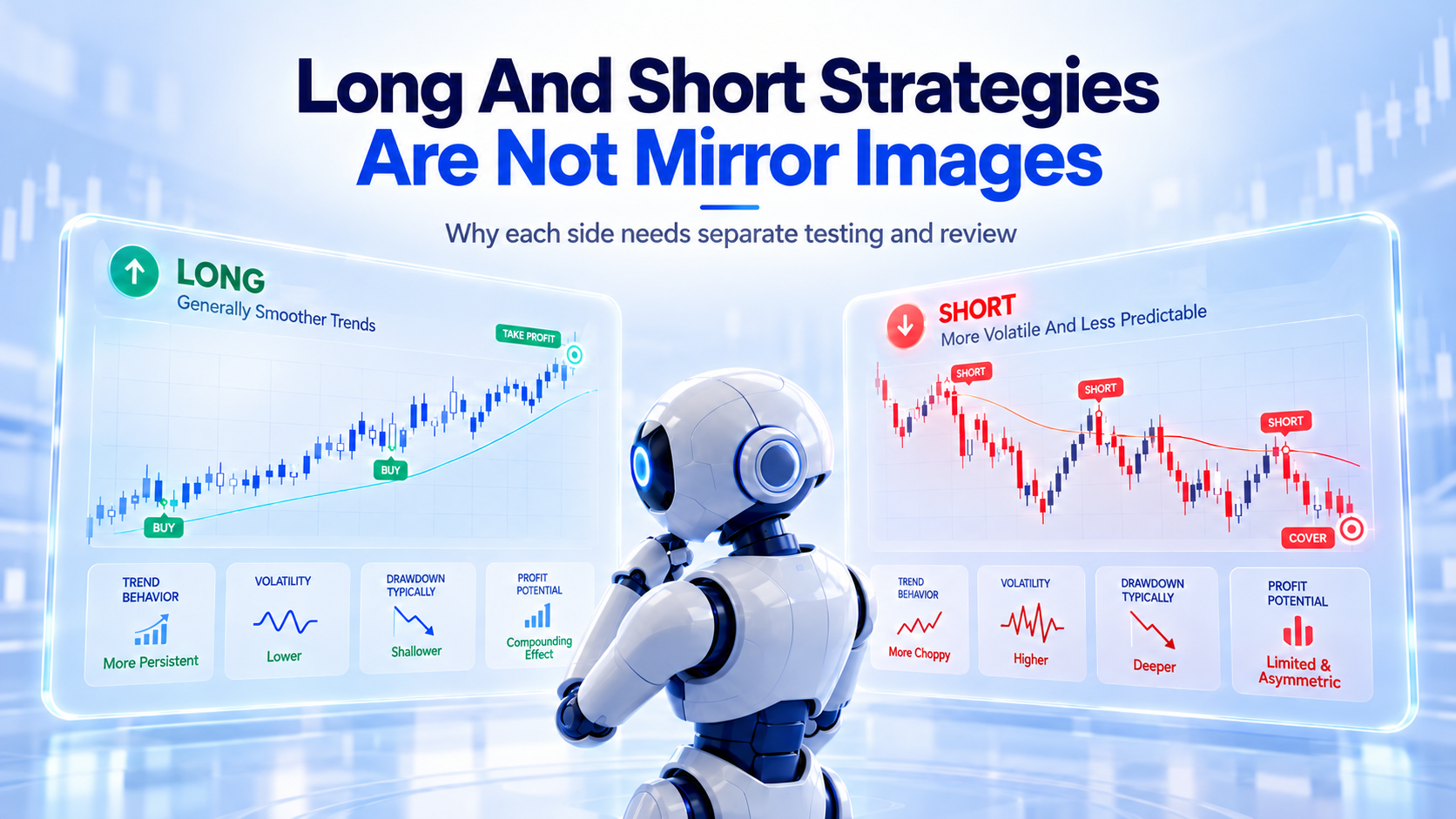
A strategy can be written with a long entry and the exact opposite short entry. That does not make its behaviour symmetrical.
Markets do not rise and fall in the same way. Uptrends can develop gradually and persist for months. Sell-offs can be faster, more volatile, and more sensitive to news, liquidity, and gaps. A filter that improves the long side may unintentionally remove most short trades. A stop that works in quiet advances may be too tight during a fast decline.
For that reason, a bidirectional strategy should be reviewed as two related systems: one for long exposure and one for short exposure.
Why the Same Rule Produces Different Results
Take a simple trend rule: go long when a fast moving average crosses above a slow moving average; go short on the reverse cross. On paper, the rule is perfectly mirrored.
In practice, the long side may benefit from a broad upward drift in the instrument. The short side may enter late during reversals, get whipsawed in rebounds, or trade less often because a trend filter is more frequently bullish. The two sides can have different trade counts, average holding times, drawdowns, and transaction costs.
That is not necessarily a flaw. It is information about the strategy.
Start With Separate Reports
When reviewing a two-sided backtest, separate the results before looking at the total.
Check how many long and short trades occurred. Compare their win rates, average wins, average losses, profit factors, and maximum drawdowns. Review which years or regimes produced the gains. If one side has only a small number of trades, do not let the combined total hide the weak evidence.
Then inspect the rules. Does a long-only market filter remain active when evaluating short entries? Does the short rule require several conditions that rarely line up? Are exits genuinely mirrored, or do they behave differently because of gaps and volatility?
A Practical Example
Imagine a Supertrend and moving-average strategy that produces 160 long trades and 18 short trades. The combined result looks respectable, but the short side contributes little and has a large average loss.
Calling this a robust bidirectional strategy would be premature. It may be a long-biased strategy with an unproven short module. The next experiment could be to review the short filter alone while leaving the long rules unchanged. That makes the change easier to understand and test.
Do Not Force Symmetry
The goal is not to make long and short performance identical. It is to understand the difference before assigning risk.
Some strategies may be more honest and easier to manage as long-only systems. Others may use separate filters, sizing, or exits for each direction. Any such decision should be based on explicit rules and fresh testing, not on a desire for a neat-looking strategy label.
Use the FlyTradr Strategy Builder to keep entry, exit, and risk rules explicit, then review each side in the Backtesting Lab.
The Bottom Line
Opposite rules do not guarantee opposite behaviour.
Review long and short trades separately before trusting the combined result.
Compare trade count, drawdown, costs, and regime behaviour on both sides.
Change one side at a time when investigating a problem.
The useful question is not “does this strategy trade both directions?” It is “do I understand the evidence and risk on each direction?”
Comments
Ask a question or leave feedback. Guests can post too.
Max 2000 characters.
No comments yet.
Quick answers
What is this article about?
A bidirectional strategy can behave very differently on each side.
Who should read this article on Long and Short Strategies Are Not Mirror Images?
This article is for retail traders who want a practical understanding of long and short strategies are not mirror images before moving into backtesting, simulation, paper trading, or broker-connected execution.
What should I do after reading this article?
Use the article to clarify the concept first, then review FlyTradr workflow pages such as the algo trading platform overview, methodology and assumptions, or the FAQs page before making a platform decision.