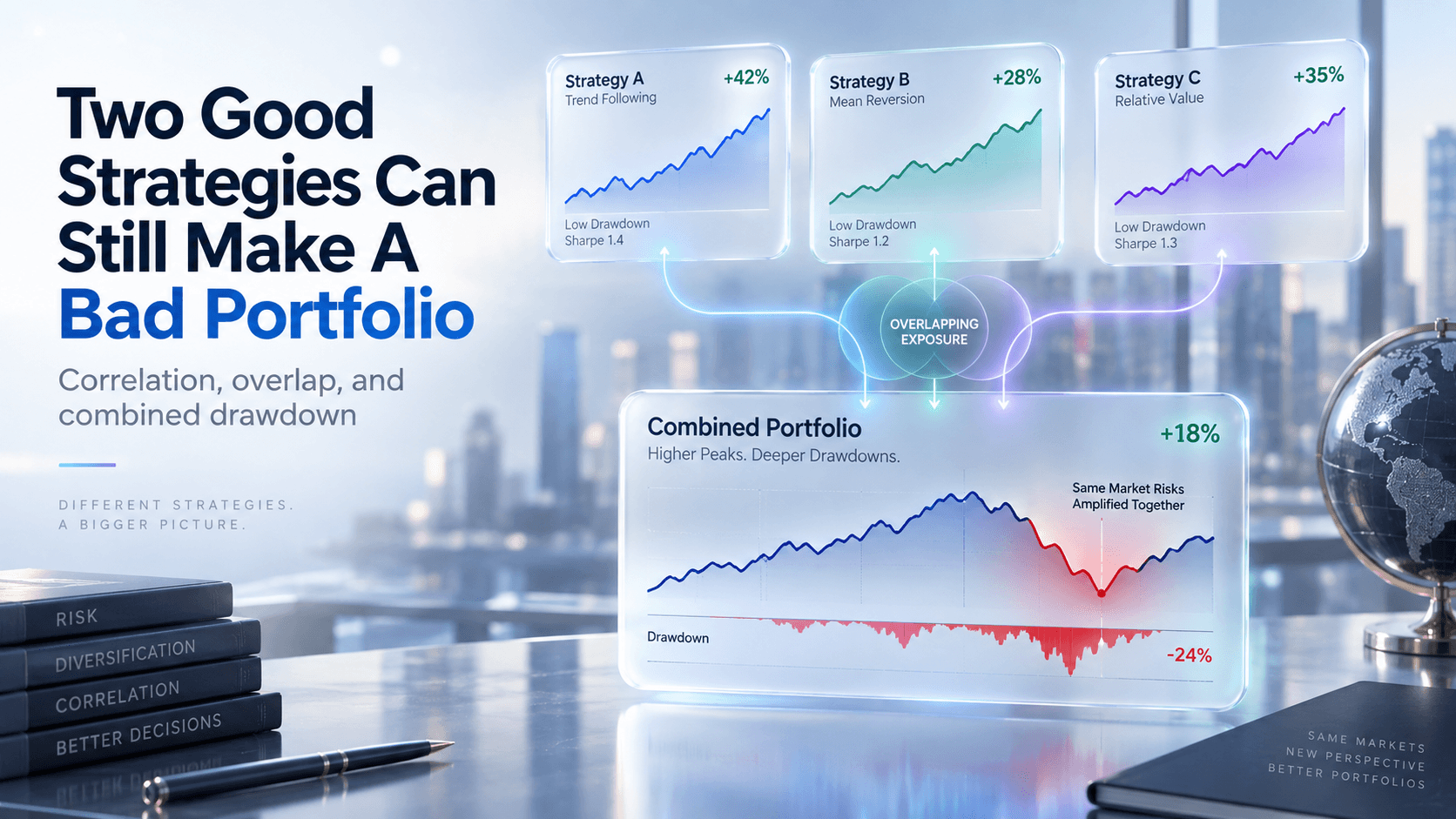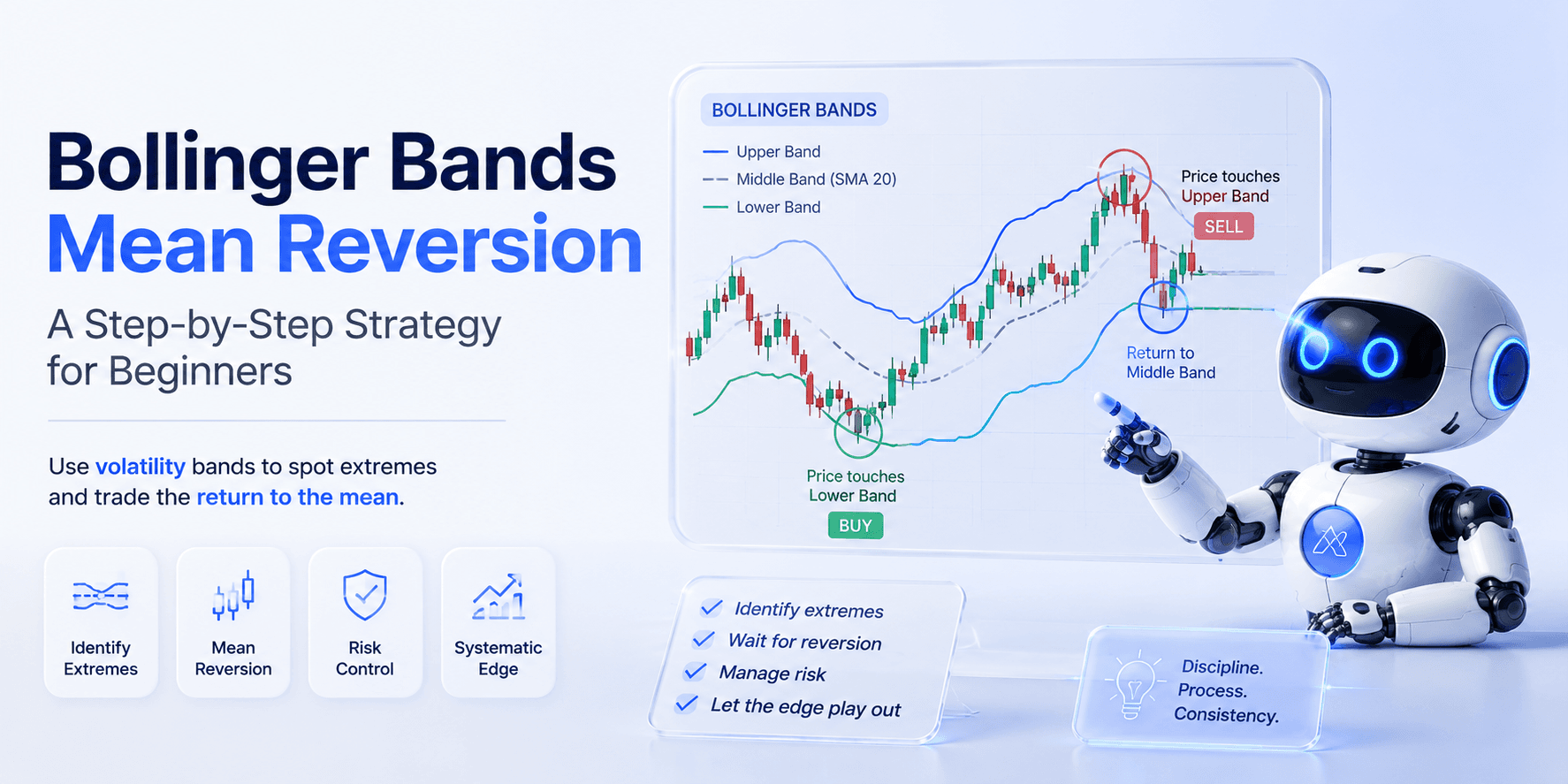


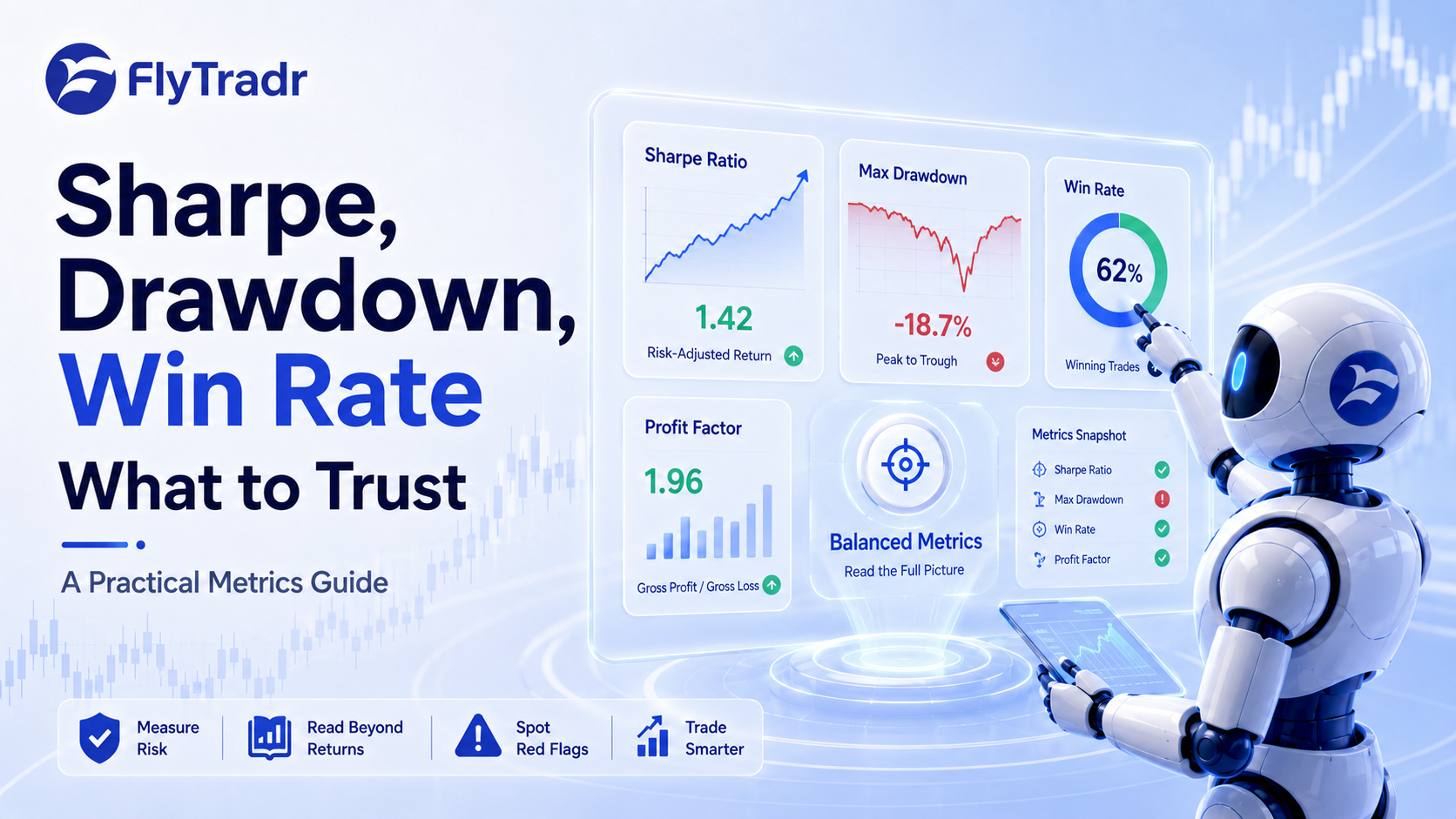
A Practical Metrics Guide: Sharpe, Drawdown, Win Rate—What to Trust
Your backtest shows:
Total return: 80%
Sharpe ratio: 3.5
Win rate: 75%
Your reaction: "This is amazing!"
Reality: These numbers might be completely misleading.
Why? Because metrics can lie—or at minimum, tell incomplete stories.
In this guide, we'll break down the most common performance metrics:
What each one actually measures
What it reveals (and what it hides)
Which ones to trust
How to spot red flags
The metrics that matter
1. Total return
What it measures: How much your account grew (or shrank) during the test period.
Formula:
`` Total Return = (Ending Balance - Starting Balance) / Starting Balance × 100% `
Example:
Starting balance: $10,000
Ending balance: $15,000
Total return: ($15,000 - $10,000) / $10,000 = 50%
What it reveals:
Whether the strategy made money (positive return) or lost money (negative return)
What it hides:
Time period: 50% in 1 year is great. 50% in 10 years is terrible.
Risk: Did you make 50% with smooth, steady gains? Or wild swings?
Survivability: Did you ever drop -40% before recovering to +50%?
Red flags:
❌ Returns too good to be true (100%+ annual on a low-risk strategy)
❌ Returns only positive in bull markets (test it on 2022 data)
What to trust:
✅ Annualized return (adjusts for time period)
✅ Risk-adjusted return (Sharpe ratio, covered below)
Bottom line: Total return alone means almost nothing. Always pair it with risk metrics.
2. Sharpe ratio
What it measures: Return per unit of risk (volatility).
Formula:
Sharpe Ratio = (Strategy Return - Risk-Free Rate) / Standard Deviation of Returns
Simplified:
Sharpe = Avg Return / Volatility
Example:
Avg annual return: 20%
Risk-free rate: 4% (Treasury bonds)
Standard deviation (volatility): 10%
Sharpe ratio: (20% - 4%) / 10% = 1.6
What it reveals:
How much return you're getting per unit of risk
Whether the strategy is efficient (high return with low volatility = good)
What it hides:
Tail risk: Sharpe assumes normal distribution. Black swan events (crashes) aren't captured.
Drawdown severity: A strategy can have great Sharpe but still drop -30% in one month.
Win distribution: 10 small wins + 1 massive loss can still show decent Sharpe.
Red flags:
❌ Sharpe > 3.0 on a backtest (probably curve-fit)
❌ Sharpe varies wildly across different test periods (unstable strategy)
What to trust:
✅ Out-of-sample Sharpe (from walk-forward testing)
✅ Live trading Sharpe (after 6-12 months)
Bottom line: Sharpe ratio is one of the best metrics, but don't use it alone. Pair with max drawdown.
3. Max drawdown
What it measures: The largest peak-to-trough decline in your account.
Formula:
Max Drawdown = (Peak Balance - Trough Balance) / Peak Balance × 100%
Example:
Account peaks at $15,000
Drops to $12,000
Max drawdown: ($15,000 - $12,000) / $15,000 = 20%
What it reveals:
The worst-case scenario you experienced during the test
How much pain you'd endure before the strategy recovers
What it hides:
Duration: Did the drawdown last 1 week or 6 months?
Frequency: Was this the only drawdown, or did you hit -15% five times?
Future drawdowns: The worst drawdown is usually still ahead of you.
Red flags:
❌ Max drawdown > 30% (you'll quit before the strategy recovers)
❌ Multiple drawdowns > 20% (strategy is too volatile)
❌ Recovery time > 6 months (psychologically unbearable)
What to trust:
✅ Max drawdown + recovery time (how long did it take to get back to break-even?)
✅ Drawdown-to-return ratio (max DD should be < 50% of total return)
Example:
Total return: 40%
Max drawdown: 25%
Ratio: 25% / 40% = 62.5%
Interpretation: You risked 62.5% of your gains to achieve them. That's high. Ideally, this ratio should be < 50%.
Bottom line: Max drawdown tells you how much pain you'll endure. If you can't handle it, the strategy won't work for you—even if it's profitable.
4. Win rate
What it measures: Percentage of trades that were profitable.
Formula:
Win Rate = (Number of Winning Trades / Total Trades) × 100%
Example:
Total trades: 100
Winning trades: 60
Win rate: 60 / 100 = 60%
What it reveals:
How often you're "right"
What it hides:
Profit size: Winning 90% of the time means nothing if your losses are huge.
Strategy type: Mean-reversion strategies often have high win rates (70-80%). Trend-following strategies often have low win rates (30-40%).
The win rate trap:
Most beginners chase high win rates. This is a mistake.
Example:
Strategy A (high win rate, low reward/risk):
Win rate: 80%
Avg win: $50
Avg loss: $200
Expected value: (0.8 × $50) + (0.2 × -$200) = $40 - $40 = $0
Strategy B (low win rate, high reward/risk):
Win rate: 40%
Avg win: $300
Avg loss: $100
Expected value: (0.4 × $300) + (0.6 × -$100) = $120 - $60 = $60
Strategy B is more profitable, despite a lower win rate.
Red flags:
❌ Win rate > 85% (probably cherry-picked or curve-fit)
❌ Win rate < 30% (unless avg win >> avg loss)
What to trust:
✅ Win rate + profit factor (covered below)
✅ Win rate + avg win/loss ratio
Bottom line: Win rate is psychologically important (feels good to be right), but mathematically, it's less important than reward/risk ratio.
5. Profit factor
What it measures: Total profit divided by total loss.
Formula:
Profit Factor = Total Profit from Wins / Total Loss from Losses
Example:
Total profit: $10,000
Total loss: $4,000
Profit factor: $10,000 / $4,000 = 2.5
What it reveals:
For every $1 you lose, how much do you make?
What it hides:
Trade distribution: Are your wins consistent, or is one massive win inflating the number?
Risk of ruin: Even a profit factor of 2.0 can blow up if you hit a bad streak.
Red flags:
❌ Profit factor > 3.0 (check for overfitting)
❌ Profit factor relies on 1-2 huge wins (not repeatable)
What to trust:
✅ Profit factor > 1.5 with consistent wins
✅ Profit factor stable across multiple test periods
Bottom line: Profit factor is a great summary metric. If it's < 1.5, your strategy needs work.
6. Risk of ruin
What it measures: Probability of losing your entire account.
Formula (simplified):
Risk of Ruin ≈ ((1 - Win Rate) / (1 + Win Rate))^(Account / Risk per Trade)
Example:
Win rate: 50%
Risk per trade: 2%
Account: $10,000
Risk of ruin: Very low (because risk per trade is small relative to account).
What it reveals:
How likely you are to go broke, even with a profitable strategy
What it hides:
Assumes consistent risk per trade (if you double down after losses, risk spikes)
Assumes independent trades (if your strategy has correlated losses, risk is higher)
Red flags:
❌ Risk of ruin > 5% (too dangerous)
❌ Risking > 3% per trade (courting disaster)
What to trust:
✅ Risk 1-2% per trade max (keeps risk of ruin near zero)
Bottom line: Risk of ruin is the most important metric for survival. Ignore it, and you'll blow up—even with a profitable strategy.
The metrics you should ignore (or use carefully)
1. Number of trades
Why it's misleading:
100 trades in 1 year sounds impressive
But if 90 are tiny winners and 10 are massive losses, you're not profitable
When it matters:
If you have < 30 trades, your backtest isn't statistically significant
If you have > 1,000 trades, you might be over-trading (slippage/commissions will kill you)
2. Avg win vs avg loss
Why it's misleading:
"Avg win = $200, Avg loss = $100" sounds great
But if you only win 30% of the time, you're losing money
When it matters:
Pair with win rate to calculate expected value:
` Expected Value = (Win Rate × Avg Win) - (Loss Rate × Avg Loss) ``
3. Total number of consecutive wins
Why it's misleading:
"10 consecutive wins!" sounds amazing
But it's probably luck, not skill
When it matters:
If your strategy requires consecutive wins to be profitable, it's fragile
How to interpret metrics together
Don't look at one metric in isolation. Use them as a system:
The "good strategy" checklist:
✅ Sharpe ratio > 1.0 (preferably > 1.5)
✅ Max drawdown < 20% (preferably < 15%)
✅ Profit factor > 1.5 (preferably > 2.0)
✅ Risk of ruin < 5% (achieved with 1-2% risk per trade)
✅ Win rate matches strategy type (mean reversion: 60-80%, trend: 30-50%)
✅ Drawdown-to-return ratio < 50%
Example:
Strategy A:
Total return: 60%
Sharpe: 1.8
Max DD: 12%
Profit factor: 2.2
Win rate: 55%
Verdict: ✅ Good strategy. Proceed to walk-forward testing.
Strategy B:
Total return: 120%
Sharpe: 0.9
Max DD: 35%
Profit factor: 1.3
Win rate: 48%
Verdict: ❌ Too risky. High return is offset by massive drawdowns and low Sharpe. Redesign.
How FlyTradr helps you analyze metrics
FlyTradr's Backtesting Lab calculates all key metrics automatically:
Performance dashboard:
Returns: Total, annualized, monthly breakdown
Risk metrics: Sharpe ratio, max drawdown, volatility
Trade metrics: Win rate, profit factor, avg win/loss
Equity curve: Visual representation of growth + drawdowns
Red flag detection:
FlyTradr highlights:
⚠️ Sharpe > 3.0 (possible overfitting)
⚠️ Max DD > 30% (high risk)
⚠️ Win rate > 85% (suspiciously high)
⚠️ Profit factor < 1.2 (marginally profitable)
Comparative analysis:
Compare metrics across:
Different time periods (bull vs bear markets)
Different instruments (SPY vs QQQ)
Different parameter sets (RSI 10 vs RSI 14)
The bottom line
The metrics that matter most:
Sharpe ratio (risk-adjusted returns)
Max drawdown (worst-case pain)
Profit factor (win/loss ratio)
Risk of ruin (survival probability)
The metrics that are misleading:
Total return (without risk context)
Win rate (without profit context)
Avg win/loss (without frequency context)
The rule:
Never trust a single metric. Always look at the full picture: returns, risk, consistency, and survivability.
Next steps
Backtest your strategy in FlyTradr's Backtesting Lab
Review all metrics (not just total return)
Check for red flags (Sharpe > 3.0, DD > 30%, etc.)
If metrics pass, proceed to walk-forward testing
If they don't, redesign and retest
Remember: A strategy with mediocre returns and great risk metrics beats a strategy with amazing returns and terrible risk metrics.
Survivability > profitability.
Ready to analyze your strategy properly? Start backtesting with full metrics at FlyTradr.
Comments
Ask a question or leave feedback. Guests can post too.
Max 2000 characters.
No comments yet.
Quick answers
What is this article about?
Every backtest shows impressive numbers.
Who should read this article on A Practical Metrics Guide: Sharpe, Drawdown, Win Rate—What to Trust?
This article is for retail traders who want a practical understanding of a practical metrics guide: sharpe, drawdown, win rate—what to trust before moving into backtesting, simulation, paper trading, or broker-connected execution.
What should I do after reading this article?
Use the article to clarify the concept first, then review FlyTradr workflow pages such as the algo trading platform overview, methodology and assumptions, or the FAQs page before making a platform decision.