Strategy Versioning: How to Change Trading Rules Without Losing What You Learned
You run a backtest and the result is disappointing. The return is lower than expected, a series of losing trades creates an uncomfortable drawdown, and the strategy seems to struggle during certain market conditions. You decide to improve it by changing an indicator period, adding a trend filter, tightening the stop loss, adjusting the exit, and trying a different timeframe.
The next backtest looks much better. Returns have improved and the equity curve is smoother. It feels like progress, but there is a problem. You cannot confidently explain which change helped, which one made no difference, or whether some of the improvement came from simply finding a combination that happened to fit the historical data.
This is a common trap in strategy development. Testing new ideas is necessary, but without a record of what changed and why, experimentation can become a collection of unrelated results. Eventually, a trader may have several promising configurations without knowing which assumptions each one depends on.
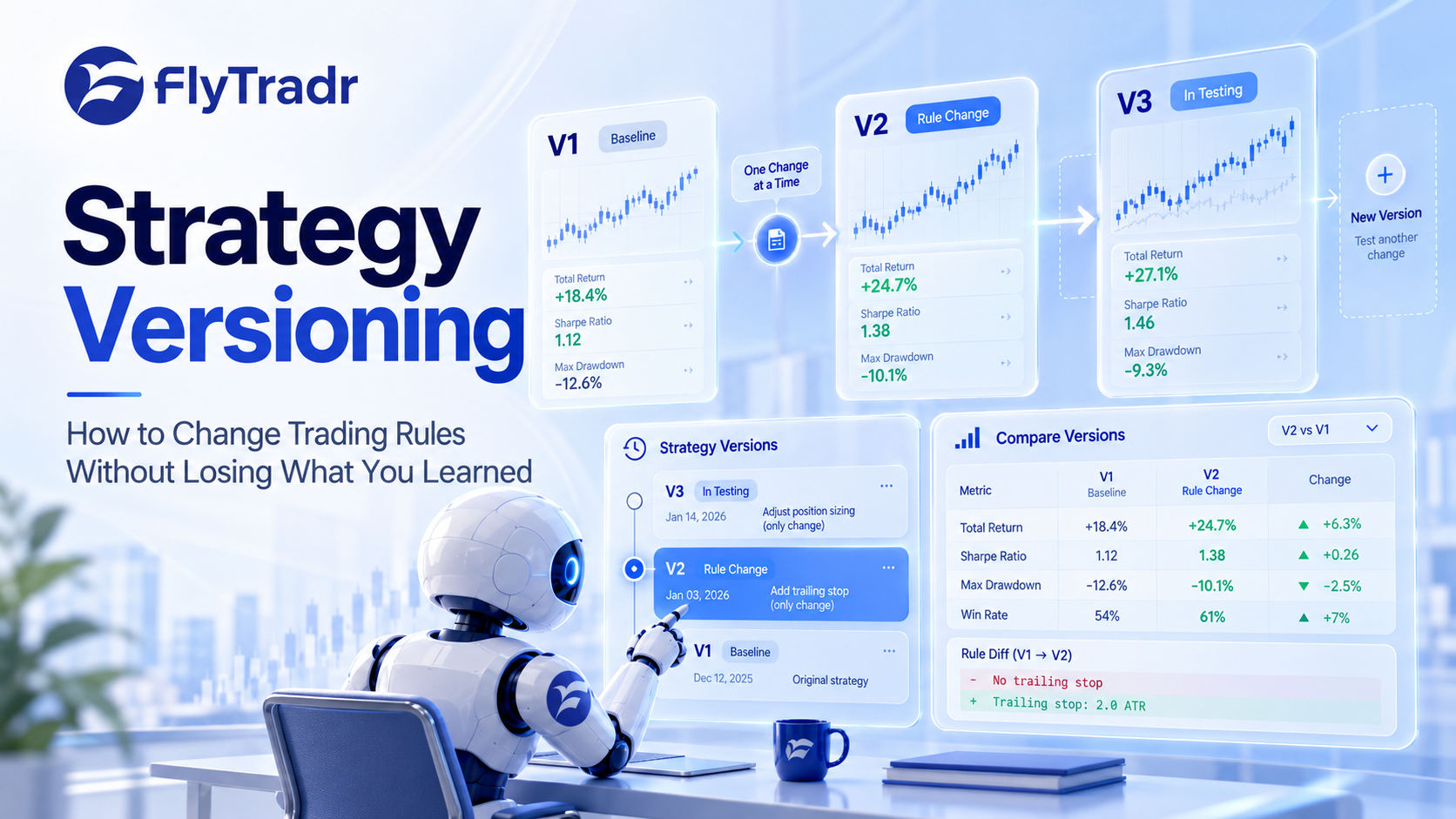
Strategy versioning provides a practical way to avoid that problem. It means treating meaningful changes to strategy rules as separate, documented versions, each linked to a question, a set of test conditions, and an outcome. The purpose is to preserve what you have learned so that the next experiment builds on evidence rather than memory.
Why Strategy Versioning Matters
A trading strategy is more than its latest set of settings. It is a collection of decisions about how to identify opportunities, manage positions, control risk, and respond to changing conditions. When those decisions change, the strategy being tested changes as well.
Consider a moving average strategy that produces an unusually large drawdown during sideways markets. One possible response is to add a filter intended to reduce trades when the market lacks direction. Another is to change the holding period or stop loss. Each proposal addresses the problem differently, and each may introduce new costs. A filter might reduce drawdown by avoiding weak entries, but it could also remove profitable trades. A tighter stop might limit some losses while increasing the number of small losing trades.
If you change all these rules together, the next result tells you whether the whole new configuration performed differently. It does not tell you which particular change was responsible. Versioning helps separate those questions and keeps a record of the tradeoffs.
It also helps when you return to a strategy months later. Instead of trying to remember why a rule exists, you can see the original hypothesis, the evidence that supported or weakened it, and the reason the change was retained or rejected.
Begin With a Baseline You Can Reproduce
Before making changes, establish a baseline version. This should be a complete, clearly defined strategy rather than a vague description of an idea.
The baseline needs to capture the market and instrument, timeframe, indicators, entry and exit conditions, direction of trading, position sizing, risk controls, and execution assumptions. It should also record the historical test period and the data source where relevant. These details matter because two tests cannot be compared fairly if their underlying conditions are different in ways you have not accounted for.
For example, suppose the baseline is a bidirectional trend strategy tested on the same instrument over a fixed historical period. You discover that the short side produces far fewer trades than the long side. That observation becomes the starting point for the next experiment, and the baseline remains available as your reference.
It is useful to preserve the original result even when it is poor. Disappointing results can reveal where the strategy struggles, and deleting them makes it easier to forget why later changes were attempted.
Change One Question at a Time
The simplest way to make an experiment interpretable is to begin with one specific question. Instead of deciding to make the strategy more profitable, identify the behaviour you want to investigate.
Suppose a strategy uses a trend filter for both long and short entries, and the short side rarely activates. Your question might be whether the existing filter is preventing otherwise valid short entries. In the new version, remove that filter from the short side while keeping the long rules, exits, risk settings, timeframe, and test window unchanged.
Now the comparison has a clear purpose. You can see whether short trade frequency changed, whether the additional trades improved or worsened performance, and whether drawdown or average trade quality suffered. Even if the result is worse, the experiment has produced useful information.
Changing one element at a time is a strong default for diagnosing behaviour, although some strategy elements interact. A filter may work differently depending on the exit rule, and a stop may behave differently at another timeframe. After testing individual changes, more structured experiments can examine those interactions. The important principle is to define the comparison before running it and keep the changes understandable.
What Each Version Should Record
A useful version history needs more than a name and a backtest screenshot. Each version should preserve enough context for someone, including your future self, to understand what was tested.
At minimum, record the version identifier, the parent version it came from, the question being investigated, the exact rule or setting that changed, and what remained unchanged. Record the market, symbol, timeframe, historical period, data assumptions, trading costs, and risk settings used for the comparison.
Then preserve the results that explain the strategy's behaviour. Total return is relevant, but so are maximum drawdown, trade count, profit factor, average trade, average win and loss, losing streaks, and the distribution of results across market conditions. If the strategy trades in both directions, consider reviewing long and short performance separately.
A short conclusion is equally valuable. Did the proposed change solve the original problem? Did it create a new weakness? Was the result inconclusive because there were too few trades? Should the version be retained for further validation, rejected, or set aside until more evidence is available?
This turns a saved configuration into a research record. You are preserving the reason behind a decision, not only the settings that happened to produce a particular result.
Compare Like With Like
A comparison becomes unreliable when several conditions change without being documented. If Version 2 uses a different timeframe, a longer historical period, lower trading costs, and a modified stop, then an improvement in returns cannot be attributed confidently to any one factor.
For a focused test, start by holding the market, historical window, position sizing approach, fees, slippage assumptions, and other unrelated settings constant. Compare the original version with the modified one under those same conditions. Review the trade list as well as the headline metrics, because a higher return may have come with more trades, worse average losses, or additional risk that is less obvious on the equity curve.
After the focused comparison, it can be useful to repeat the test under different historical periods, costs, or market regimes. Those are separate robustness checks rather than part of the original controlled comparison. Keeping the stages distinct helps you understand both what changed and whether the improvement persists outside the conditions where it was first observed.
Be particularly careful when comparing strategies using different capital allocations. A version that takes more risk may naturally produce a higher return. Without reviewing exposure and drawdown, that may be mistaken for an improvement in strategy quality.
A Better Return Does Not Always Mean a Better Version
It is tempting to judge every experiment by the return shown at the top of the backtest report. Yet a version can produce a higher return while becoming more fragile.
A new filter may improve the backtest because it happened to avoid one particularly difficult historical period. A shorter timeframe may generate substantially more trades, producing a stronger gross result while increasing sensitivity to costs and slippage. A more aggressive exit may improve the ending balance while creating longer drawdowns or larger individual losses.
The review should therefore ask whether the change improved the behaviour it was intended to address. If the objective was to reduce exposure during sideways markets, did it actually do that? If the objective was to improve the short side, was improvement spread across several market conditions, or did it come from one unusually favourable period?
A version that performs less impressively in headline terms may still be worth keeping if it has clearer behaviour, more stable parameters, or a risk profile that is easier to manage. Conversely, a spectacular result that depends on narrow assumptions should remain a candidate for further testing rather than immediately becoming the new default.
How Research Drift Develops
Research drift happens when a strategy gradually changes direction without a clear decision trail. The trader starts with a trend-following idea, adds a filter to fix one drawdown, modifies the exit to repair another period, changes the timeframe to increase activity, and then adds more conditions because the latest version still has weaknesses.
After many rounds, the strategy can look very different from the original idea. Its rules may no longer reflect a market behaviour that can be explained clearly. Each addition seemed reasonable when it was made, but the cumulative result may be a strategy shaped around the particular historical data used during development.
Version history makes this visible. It shows whether the research is moving toward a clearer hypothesis or merely reacting to the last disappointing result. It also allows you to return to an earlier version instead of continuing to add complexity.
This is closely related to overfitting. Running many experiments against the same historical period creates more opportunities to find improvements by chance. Even carefully documented versions can overfit if the final choice is always the configuration with the best in-sample result. Versioning improves research discipline, but it must be combined with fresh testing to evaluate whether an apparent improvement generalises.
Keep Fresh Data Separate From Development
A controlled comparison can tell you what changed within a historical sample. It does not prove that the revised strategy will behave similarly in new conditions.
Once a version appears promising, test it on data that was not used to design or select the change. Out-of-sample testing or a properly designed walk-forward process can reveal whether the improvement survives beyond the development period. Review performance across different market regimes, and stress test costs and execution assumptions where relevant.
There is an important discipline here. If you inspect the out-of-sample result, make another adjustment, and repeat this process many times, that supposedly fresh data starts influencing development. It gradually stops being a truly independent test.
The better approach is to distinguish development experiments from final validation, record when data has been used to inform a decision, and reserve genuinely unseen evidence where possible. Paper trading can provide another forward-looking observation, although it too needs a meaningful sample and realistic interpretation.
When Multiple Changes Are Necessary
Some improvements cannot be represented honestly as a single isolated rule change. A new execution model might require changes to signal timing, order type, and exit handling together. A major redesign may alter the strategy's basic premise.
In those cases, create a clearly labelled new branch or major version instead of pretending that it is a minor adjustment. Document the full scope of the redesign and evaluate it as a new configuration. It may no longer be appropriate to attribute its results to the effect of one rule.
You can then run smaller, controlled experiments within that redesigned version. This keeps the process flexible without sacrificing the clarity that versioning is meant to provide.
A Practical Strategy Review Workflow
A repeatable workflow begins by preserving a baseline strategy and its original backtest. Identify one behaviour that deserves investigation and write down what you expect the proposed change to affect. Create a new version that changes only the necessary part of the strategy and run it against the same comparison period and assumptions.
Review both improvements and deterioration. Look at the relevant trade behaviour, drawdown, average trade, and consistency, rather than relying only on the final return. Record the conclusion and decide whether the version should move to broader stress testing, remain experimental, or be rejected.
When a version survives those checks, validate it on fresh data and observe it through simulation or paper trading where appropriate. Only after that should it be considered for deployment, with risk controls and monitoring suited to the actual strategy.
This process creates a chain of decisions that can be reviewed later. A failed experiment is still worthwhile if it eliminates a weak assumption or reveals a hidden dependency. Over time, that evidence can become more valuable than any single impressive backtest.
How FlyTradr Fits Into the Workflow
FlyTradr is built around turning trading ideas into explicit rules and testing those rules before deployment. The Strategy Builder helps define the logic, while the Backtesting Lab provides a place to review historical results and compare variations.
Keeping strategy versions and test assumptions organised is particularly useful when experimenting with entry filters, exits, risk settings, and timeframes. A reviewable proposal from FlyTradr AI, where supported, can also make a change easier to inspect by clarifying which part of the strategy is proposed for modification and what is intended to remain unchanged. The trader still reviews and decides whether to use the proposal.
The Simulator and Paper Trader provide additional stages for examining behaviour after historical testing. These steps do not remove the need for careful judgement, but they support a more structured path from an initial idea to a version that has undergone meaningful validation.
The objective is to make experimentation easier to follow without treating every new result as proof that the strategy has improved.
The Bottom Line
Strategy development inevitably involves making changes. Indicators are adjusted, rules are refined, weak periods are investigated, and new ideas are tested. What matters is whether each experiment leaves you with a better understanding of the strategy.
Versioning helps preserve that understanding. It gives each meaningful change a reason, a comparison, and an outcome. It encourages traders to keep assumptions consistent, document tradeoffs, and return to earlier versions when new complexity does not earn its place.
A better-looking backtest is useful only when you understand why it changed and whether that improvement survives further scrutiny. The most credible research process is one in which the strategy evolves through understandable decisions, and the evidence remains available long after the latest chart has been replaced.
Comments
Ask a question or leave feedback. Guests can post too.
Max 2000 characters.
No comments yet.
Quick answers
What is this article about?
A better backtest is not always a better strategy.
Who should read this article on Strategy Versioning: How to Change Trading Rules Without Losing What You Learned?
This article is for retail traders who want a practical understanding of strategy versioning: how to change trading rules without losing what you learned before moving into backtesting, simulation, paper trading, or broker-connected execution.
What should I do after reading this article?
Use the article to clarify the concept first, then review FlyTradr workflow pages such as the algo trading platform overview, methodology and assumptions, or the FAQs page before making a platform decision.