

Walk-Forward Testing: Why One Backtest Is Not Enough
A standard backtest tells you how a trading strategy would have performed across a historical dataset. It is a useful starting point, but it is not complete validation.
The limitation is this: a backtest treats your strategy parameters as fixed. You choose your parameters, run the strategy across the historical period, and evaluate the result. But in live trading, market conditions change. A parameter set that was well suited to 2020 volatility may perform differently in 2023. A strategy that produced strong results during a trending period may struggle in a ranging environment.
Walk-forward testing is designed to address this by asking a more realistic question: could a trader have used this strategy, re-optimised it periodically, and still made consistent money?
The Concept Behind Walk-Forward Testing
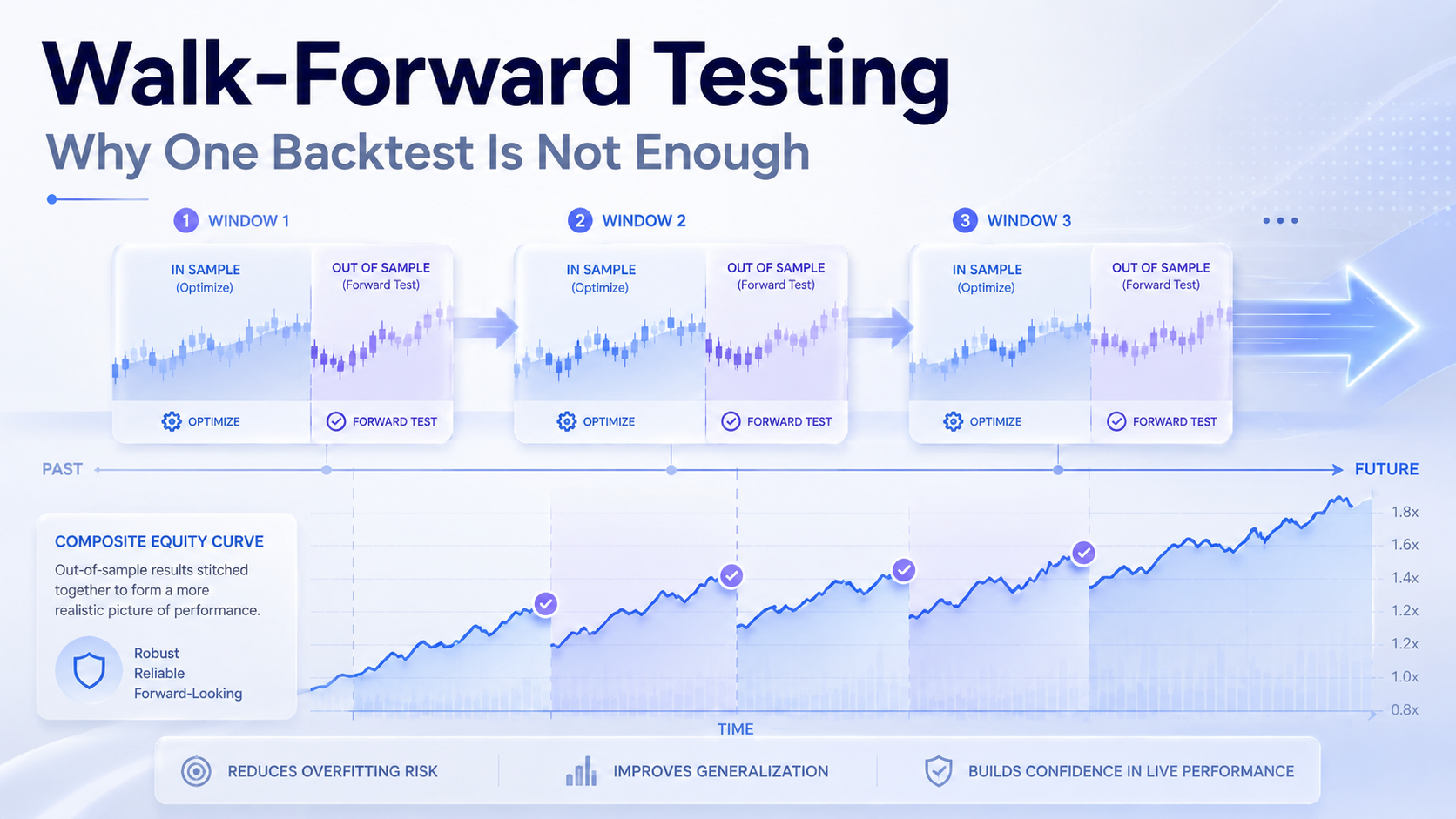
The core idea is straightforward. Instead of running a single backtest across your entire historical dataset, you divide the data into a series of rolling windows. Each window has two parts: an in-sample period and an out-of-sample period.
Here is how a single window works.
In the in-sample period, you optimise your strategy parameters. You are finding the parameter values that would have worked best on that chunk of historical data.
In the out-of-sample period, you run the strategy with those parameters on data it has never seen. You do not adjust anything during this period. You simply let the strategy run and record the results.
Then you move the window forward in time. The next in-sample period starts slightly later, overlapping with the previous one. The next out-of-sample period is the new data after that.
You repeat this across your entire historical dataset, accumulating a series of out-of-sample results. At the end, you stitch together all the out-of-sample periods to form a composite performance record.
That composite is your walk-forward result, and it represents something much closer to what you would actually have experienced as a live trader using this strategy.
Why This Is More Reliable Than a Standard Backtest
A standard backtest has a fundamental honesty problem. You optimise your parameters on the full dataset, then evaluate performance on that same dataset. The result can be inflated because the parameters have been chosen with the benefit of hindsight.
Walk-forward testing separates tuning from evaluation. The out-of-sample periods are genuinely out of sample. You are not cherry-picking parameters based on how they perform in the test period. You are using parameters chosen from prior data and running them forward.
This creates a form of forward simulation. The strategy is being evaluated on data it could not have used to tune itself. That is a meaningful difference.
It is not perfect, and no methodology is. But it gives you a more honest picture of whether the strategy has a genuine edge or whether the backtest results were largely a product of fitting to historical data.
An Example of Walk-Forward Testing in Practice
Suppose you have 10 years of daily price data, from 2015 to 2024.
You might structure your windows as follows: an in-sample period of two years, followed by an out-of-sample period of six months. You start with 2015 to 2016 as the in-sample period, then run the out-of-sample test on the first half of 2017. Then you move the window forward by six months. The new in-sample period is the second half of 2015 through the first half of 2017, and the new out-of-sample period is the second half of 2017. You continue this process through to the end of 2024.
The result is a series of out-of-sample six-month periods covering 2017 through 2024. You combine all of these into a single performance record and evaluate that.
If the combined out-of-sample performance is reasonable and consistent, the strategy has passed a meaningful test. If the out-of-sample performance is dramatically worse than the in-sample performance for each window, or if the strategy only works in certain windows and not others, that tells you something important about its reliability.
What Walk-Forward Testing Tells You That a Backtest Cannot
A standard backtest can tell you what parameter values would have worked best on your historical data. That is useful for building initial intuition, but it is limited as a predictive tool.
Walk-forward testing tells you several things a backtest cannot.
It tells you whether the strategy can survive periodic re-optimisation. If the optimal parameters change dramatically from one window to the next, the strategy is unstable. A robust strategy should have parameters that shift gradually and remain within a reasonable range across different periods.
It tells you whether the out-of-sample performance degrades significantly compared to in-sample performance. Some degradation is expected and normal. Your in-sample results will usually be better because the parameters were chosen on that data. But if the ratio of in-sample to out-of-sample performance is extreme, that is a sign of over-optimisation.
It tells you how the strategy behaves across different market regimes. Walk-forward results cover multiple market conditions: trending years, volatile years, and sideways years. You can examine whether performance is consistent across these conditions or whether the strategy only works in specific environments.
Limitations of Walk-Forward Testing
Walk-forward testing is more rigorous than a standard backtest, but it is not a guarantee of future performance.
The most significant limitation is that it is still based on historical data. The market conditions in your historical dataset may not fully represent the conditions you will face going forward. A new macroeconomic regime, a regulatory change, or a structural shift in market participants can all create conditions that your historical data did not capture.
Walk-forward testing also becomes more computationally intensive as the number of parameters and windows increases. For complex strategies with many parameters, the optimisation required at each in-sample step can be substantial.
It is also possible to over-optimise the walk-forward methodology itself. If you spend a lot of time choosing the exact window sizes and overlap ratios that produce the best walk-forward results, you are introducing a different form of the same bias you were trying to eliminate.
Where Walk-Forward Testing Fits in Your Validation Process
The most reliable validation process for a systematic strategy uses multiple layers.
Start with a standard backtest to establish that the strategy has a plausible edge on historical data. Use this to understand the basic mechanics and performance characteristics.
Apply walk-forward testing to assess whether the strategy is robust across different time periods and market conditions. This is the second layer of validation.
Move to paper trading to test the strategy in real market conditions without financial risk. This is the third layer, and the one that tests real execution, slippage, and the emotional discipline of following rules when real money is not yet at stake.
Live trading with reduced position sizes is the final layer, where you watch real execution against real market conditions.
Walk-forward testing sits between the standard backtest and paper trading. It is not a replacement for either. It is an additional check that reduces the likelihood of being deceived by a well-fitted but fragile backtest result.
Applying This Without Writing Code
Walk-forward testing has historically been difficult for retail traders to implement because it requires running many successive backtests and recording results across multiple windows. Platforms that support this natively make the process significantly more accessible.
FlyTradr's Backtesting Lab supports running your strategy across different defined time periods, which allows you to manually implement a walk-forward approach by running successive in-sample and out-of-sample tests without needing to write a single line of code.
A genuine edge in a trading strategy should survive scrutiny. Walk-forward testing is one of the more honest ways to apply that scrutiny.
You can run your strategy across custom date ranges in FlyTradr's Backtesting Lab. Set different in-sample and out-of-sample periods, compare the results, and build a more complete picture of your strategy's robustness before going live. Explore the Backtesting Lab here.
Comments
Ask a question or leave feedback. Guests can post too.
Max 2000 characters.
No comments yet.
Quick answers
What is this article about?
A single backtest tells you how a strategy would have performed on historical data.
Who should read this article on Walk-Forward Testing: Why One Backtest Is Not Enough?
This article is for retail traders who want a practical understanding of walk-forward testing: why one backtest is not enough before moving into backtesting, simulation, paper trading, or broker-connected execution.
What should I do after reading this article?
Use the article to clarify the concept first, then review FlyTradr workflow pages such as the algo trading platform overview, methodology and assumptions, or the FAQs page before making a platform decision.