

SEBI's New Algo Trading Rules for Retail Traders: What Changed in April 2026
For most of the last decade, algorithmic trading in India existed in a grey zone for retail investors. Institutions had a clear regulatory framework. Retail traders who used broker APIs to automate their strategies were technically allowed to do so, but there was no formal structure around it. Nobody had defined who was responsible if something went wrong, or what standards an automated system had to meet.
That changed on April 1, 2026, when SEBI's new algorithmic trading framework became mandatory for all stock brokers in India. The rules themselves came from a circular SEBI issued in February 2025, titled "Safer Participation of Retail Investors in Algorithmic Trading." But for most traders, the April 2026 deadline is when the rules actually started to matter.
If you are interested in automating your trading strategies, understanding what this framework actually says is worth your time.
What Was the Problem SEBI Was Solving
The older regulatory framework for algo trading in India was designed around institutional participants. High-frequency trading firms, proprietary desks, and hedge funds had always had a clear process: register with the exchanges, meet technical standards, get audited.
Retail traders were a different story. As broker APIs became more accessible and platforms like Zerodha's Kite Connect made it possible for individual traders to automate strategies, a large informal market developed. Thousands of retail traders were running automated systems with no standardised oversight. Algo vendors were selling strategy systems directly to retail clients, sometimes connecting to exchanges in ways that bypassed broker-level accountability entirely.
The concern was not that retail traders should not automate. The concern was that if something went wrong, whether a strategy misfired and created unusual market activity, or a retail trader lost money through a vendor's defective system, there was no clear accountability chain.
SEBI's 2026 framework creates that chain.
The Key Changes: What the Rules Actually Say
Every Automated Order Now Has an Identity
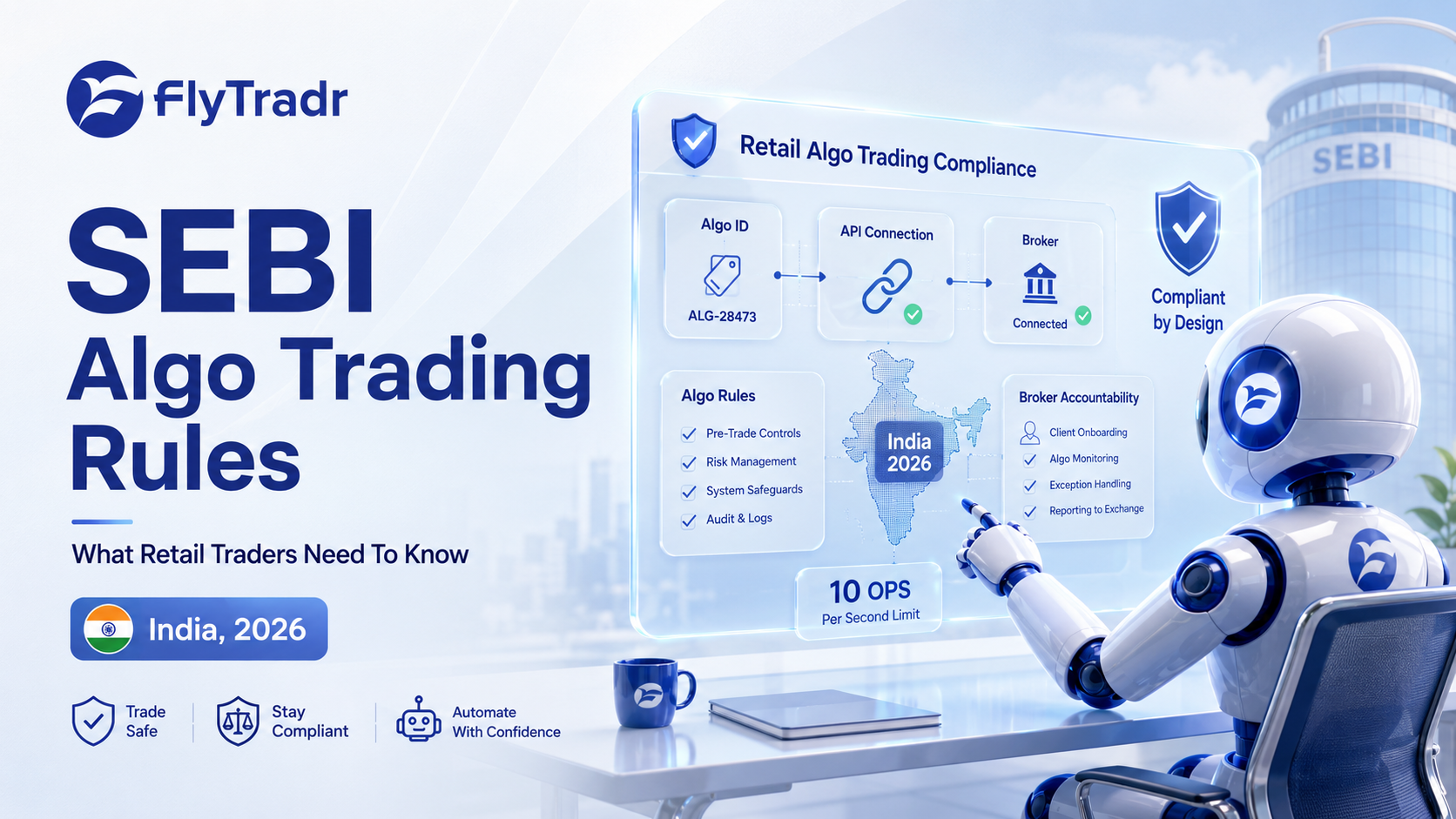
The most significant change is the introduction of the Algo-ID. From April 1, 2026, every order placed by an automated system must carry a unique identifier assigned by the exchange. This means exchanges can trace every automated order back to the specific algorithm that generated it.
In practical terms: if a strategy starts placing orders unusually fast, or if something goes wrong in a session, the exchange can look up exactly which algorithm was responsible and which broker was running it. Before this framework, this kind of traceability did not exist for retail algo orders.
The 10 Orders Per Second Threshold
Not every automated trader needs to formally register their algorithm. SEBI has set a threshold of 10 orders per second per exchange per client. Below that threshold, your strategy does not need a separate registration. Above it, mandatory registration applies.
For the vast majority of retail traders, this is not a constraint at all. A retail trader running a positional strategy on Nifty 50 stocks is typically generating a handful of orders per day, not per second. The 10 OPS threshold is designed to catch high-frequency setups, not the kind of systematic strategies most retail traders build.
Algo Providers Must Partner With Registered Brokers
This is the structural change that matters most for anyone using a third-party platform to automate strategies. Under the new framework, algo providers, meaning any platform, SaaS product, or vendor that provides automated trading systems to retail clients, cannot connect directly to exchanges. They must work through a registered broker who has formally onboarded them.
The broker is now responsible for every algo that runs through their infrastructure. Before onboarding any algo provider, the broker must conduct due diligence, verify that the system meets SEBI's technical standards, and assign an Algo-ID to the provider's strategies. If an algo causes a problem, the broker carries accountability.
This might sound like it adds friction for retail traders. In practice, it is the opposite. It means that any legitimate algo platform you use has already been vetted by a registered broker. The burden of compliance is no longer on you as an individual trader.
Static IP and Indian Server Requirements
Two technical requirements round out the framework. Retail algo traders must provide one or two static IP addresses to their broker, which the broker then whitelists. Only orders coming from those IP addresses are recognised as belonging to the registered system.
Additionally, all retail algo systems must be hosted on servers located in India. If you are using a cloud-based setup that runs on servers outside the country, that setup will need to change. For traders using broker-integrated platforms that handle their own infrastructure, this requirement is already handled on their behalf.
What This Means in Practice
If You Are a Retail Trader Who Wants to Automate
The single most important thing this framework does is make automated trading officially accessible to retail investors in India, not just institutions. For years, retail traders who wanted to automate had to navigate an informal, grey-area ecosystem. That ecosystem still exists, but there is now a regulated path alongside it.
If you are building strategies using a platform that connects through a registered broker API, and that platform has been formally onboarded under the new framework, you are operating within the rules. Most legitimate algo platforms that were serious about Indian markets have been working toward this compliance since the circular was issued in February 2025.
The 10 OPS threshold means you almost certainly do not need to register your algorithm directly. Your broker or your platform handles the formal registration side.
If You Are Using a Vendor or Third-Party Platform
The new framework is a useful filter. If the platform or vendor you are using has not partnered with a registered broker and cannot clearly explain how your strategies are being routed under the new rules, that is worth asking about. The framework creates accountability, but it only protects you if the tools you are using are operating within it.
Before connecting a broker to any automated strategy, it is worth confirming that the platform has gone through the broker onboarding process under SEBI's framework.
FlyTradr connects to Indian brokers via their official APIs. If you are looking for a no-code platform to build and deploy automated strategies through a regulated broker connection, you can explore FlyTradr's broker integrations here.
Does This Framework Limit What Retail Traders Can Do
No. If anything, it expands what retail traders can do with confidence. The rules do not restrict the complexity of strategies you can build. They do not limit how often you can trade within the 10 OPS threshold. They do not require you to be a technology expert to automate.
What they do require is that your automated activity flows through the right regulatory channel, meaning a registered broker who has onboarded your algo provider. For most retail traders using a legitimate platform, this is already taken care of in the background.
Building Your Strategy in a Regulated Framework
If you are new to algo trading and the regulatory language above feels overwhelming, here is the practical version: use a platform that connects to your broker through an official API, make sure your broker is aware of and supports the algo framework, and stay within the 10 OPS threshold, which nearly all retail strategies do automatically.
The strategy itself, how you design it, test it, and refine it before going live, remains entirely in your hands. That is where the real work happens, and it is where a good backtesting and paper trading setup becomes essential.
If you are still at the strategy-building stage, you might find it useful to read How to Turn a Manual Trading Idea Into Clear Strategy Rules and No-Code Strategy Builder: Turning an Idea Into Testable Rule
Key Takeaways
SEBI's algorithmic trading framework became mandatory for all brokers from April 1, 2026, following a circular issued in February 2025.
Every automated order now carries an exchange-assigned Algo-ID for traceability.
The 10 orders per second threshold means most retail traders do not need to register their algorithms directly.
Algo providers must work through registered brokers, not connect directly to exchanges. The broker carries accountability for the systems they onboard.
Retail algo systems must use static IPs and be hosted on Indian servers.
The framework makes algo trading officially accessible to retail investors in India, not just institutions. For traders using legitimate broker-connected platforms, the compliance is mostly handled for you.
Ready to start building and testing automated strategies within the new framework? Try FlyTradr free and connect your broker when you are ready to go live.
Comments
Ask a question or leave feedback. Guests can post too.
Max 2000 characters.
No comments yet.
Quick answers
What is this article about?
SEBI's algorithmic trading framework became mandatory from April 2026.
Who should read this article on SEBI's New Algo Trading Rules for Retail Traders: What Changed in April 2026?
This article is for retail traders who want a practical understanding of sebi's new algo trading rules for retail traders: what changed in april 2026 before moving into backtesting, simulation, paper trading, or broker-connected execution.
What should I do after reading this article?
Use the article to clarify the concept first, then review FlyTradr workflow pages such as the algo trading platform overview, methodology and assumptions, or the FAQs page before making a platform decision.